GATE 2020 EC – Question 53
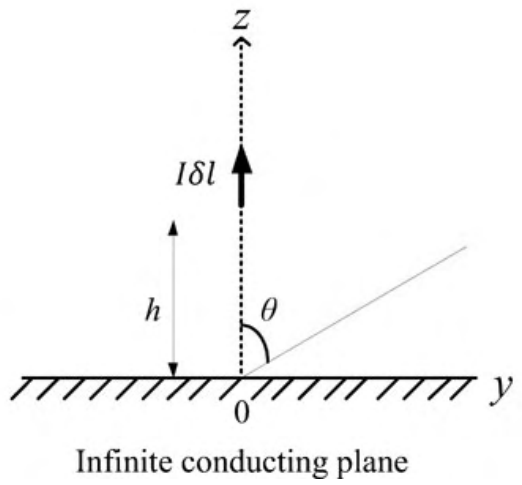
For an infinitesimally small dipole in free space, the electric field $E_\theta$ in the far field is proportional to $(e^{-jkr}/r)\sin\theta$, where $k=2\pi/\lambda$. A vertical infinitesimally small electric dipole ($\delta l\ll\lambda$) is placed at a distance $h$ ($h>0$) above an infinite ideal conducting plane, as shown in the figure. The minimum value of $h$, for which one of the maxima in the far field radiation pattern occurs at $\theta=60^\circ$, is
Practise this question in The GATE Grind →
Show answer and explanation
Correct answer: (A) $\lambda$
Explanation
The perfectly conducting plane is replaced by an image dipole carrying a current in the same direction, so the far-field pattern is $|E|\propto\sin\theta\cos(kh\cos\theta)$. A maximum at $\theta=60^\circ$ needs $\frac{d}{d\theta}=\cos\theta\cos(a\cos\theta)+a\sin^2\theta\sin(a\cos\theta)=0$ with $a=kh$, i.e. $0.5\cos\frac a2+0.75\,a\sin\frac a2=0$. The smallest positive root is $a\approx6.05$, so $h\approx0.96\lambda\approx\lambda$.