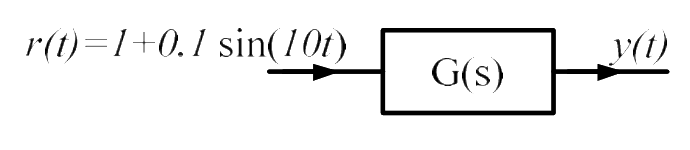
The input is $r(t)=1+0.1\sin(10t)$. The DC gain is $G(0)=1$, so $a=1$. At $\omega=10$, $G(j10)=\frac{100}{-100+j1+100}=\frac{100}{j}$, which has magnitude 100, so $b=0.1\times100=10$.
More Applications of Fourier Transform for continuous and discrete time signals, Laplace Transform and Z transform questions
GATE 2022 EE Q47– Let an input x(t)=2(10 t)+5(15 t)+7(42 t)+4(45 t) is passed through an LTI system having…
GATE 2021 EE Q41– The causal signal with z-transform z2(z-a)-2 is (u[n] is the unit step signal)
GATE 2021 EE Q42– Let f(t) be an even function, i.e. f(-t)=f(t) for all t. Let the Fourier transform of f(t)…
GATE 2021 EE Q53– Consider a continuous-time signal x(t) defined by x(t)=0 for t >1, and x(t)=1- t for t 1.…
GATE 2020 EE Q13– Which of the following statements is true about the two sided Laplace transform?
GATE 2020 EE Q14– Consider a signal x[n]=(12)n 1[n], where 1[n]=0 if n<0, and 1[n]=1 if n0. The z-transform…