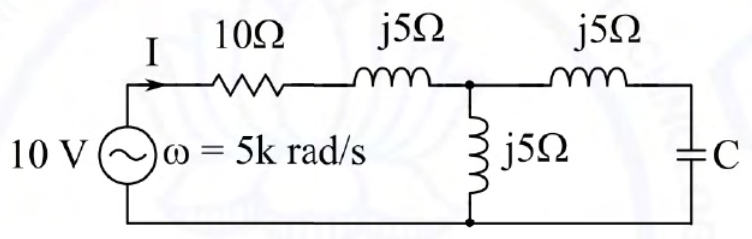
At $\omega=5$ krad/s, $I=0$ requires the impedance seen by the source to be infinite. The shunt inductor $j5\ \Omega$ is in parallel with the branch $j5\ \Omega$ in series with the capacitor ($-jX_C$), so the parallel impedance is infinite when the two susceptances cancel: $j5+j(5-X_C)=0$, i.e. $X_C=10\ \Omega$. Then $C=\frac{1}{\omega X_C}=\frac{1}{5000\times10}=20\ \mu$F.
More Transient response of DC and AC networks, sinusoidal steady-state analysis, resonance, two port networks, balanced three phase circuits, star-delta transformation, complex power and power factor in AC circuits questions
GATE 2021 EE Q30– The Bode magnitude plot for the transfer function V o(s)V i(s) of the circuit is as shown.…
GATE 2021 EE Q31– A signal generator having a source resistance of 50\ is set to generate a 1 kHz sinewave.…
GATE 2021 EE Q39– In the circuit, switch 'S' is in the closed position for a very long time. If the switch…
GATE 2020 EE Q28– Currents through ammeters A2 and A3 in the figure are 110 and 170, respectively. The…
GATE 2020 EE Q55– A resistor and a capacitor are connected in series to a 10 V dc supply through a switch.…
GATE 2019 EE Q22– In the circuit shown below, the switch is closed at t=0. The value of in degrees which…