GATE 2019 EC – Question 13
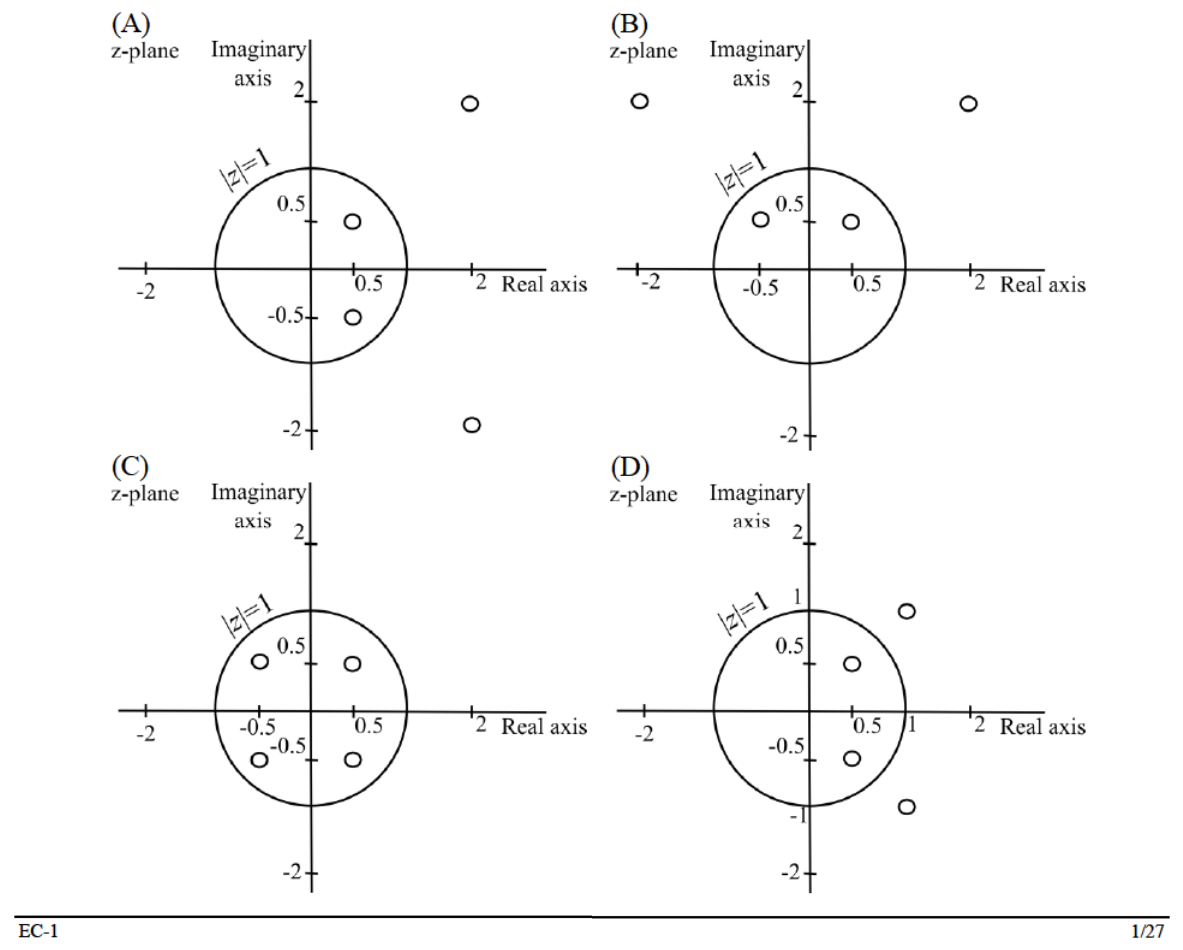
Let $H(z)$ be the z-transform of a real-valued discrete-time signal $h[n]$. If $P(z)=H(z)H\left(\frac1z\right)$ has a zero at $z=\frac12+\frac12j$, and $P(z)$ has a total of four zeros, which one of the following plots represents all the zeros correctly?
Practise this question in The GATE Grind →
Show answer and explanation
Correct answer: (D) Plot (D)
Explanation
Because $h[n]$ is real, zeros occur in conjugate pairs, and $P(z)$ is unchanged under $z\to1/z$, so zeros also occur in reciprocal pairs. Starting from $\frac12+\frac12j$ we get its conjugate $\frac12-\frac12j$ and the reciprocals $1-j$ and $1+j$. Plot (D) shows these four zeros.