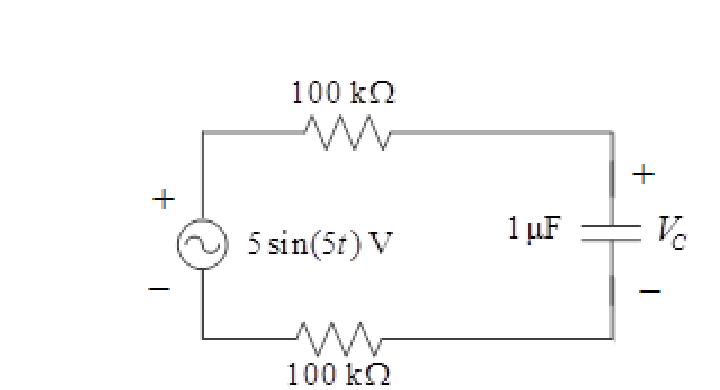
The two $100\ \text{k}\Omega$ resistors total $200\ \text{k}\Omega$ in series with the $1\ \mu$F capacitor, whose reactance at $\omega=5$ is $\frac{1}{5\times10^{-6}}=200\ \text{k}\Omega$. The divider gives $\frac{V_c}{V_s}=\frac{-j200}{200-j200}=\frac{1}{\sqrt2}\angle-45^\circ$, which for the source of amplitude 5 V gives $\frac{5}{\sqrt2}=2.5\sqrt2$ V amplitude at $-0.25\pi$.
More Sinusoidal Steady State Analysis questions
GATE 2016 EC Q41– A network consisting of a finite number of linear resistor (R), inductor (L), and…
GATE 2015 EC Q16– In the circuit shown, at resonance, the amplitude of the sinusoidal voltage (in Volts)…
GATE 2015 EC Q42– In the given circuit, the maximum power (in Watts) that can be transferred to the load R L…
GATE 2017 EC Q17– In the circuit shown, the positive angular frequency (in radians per second) at which the…
GATE 2017 EC Q44– The figure shows an RLC circuit excited by the sinusoidal voltage 100(3t) Volts, where t…
GATE 2014 EC (EC1) Q16– For maximum power transfer between cascaded network sections, how should the first…