GATE 2016 EC – Question 40
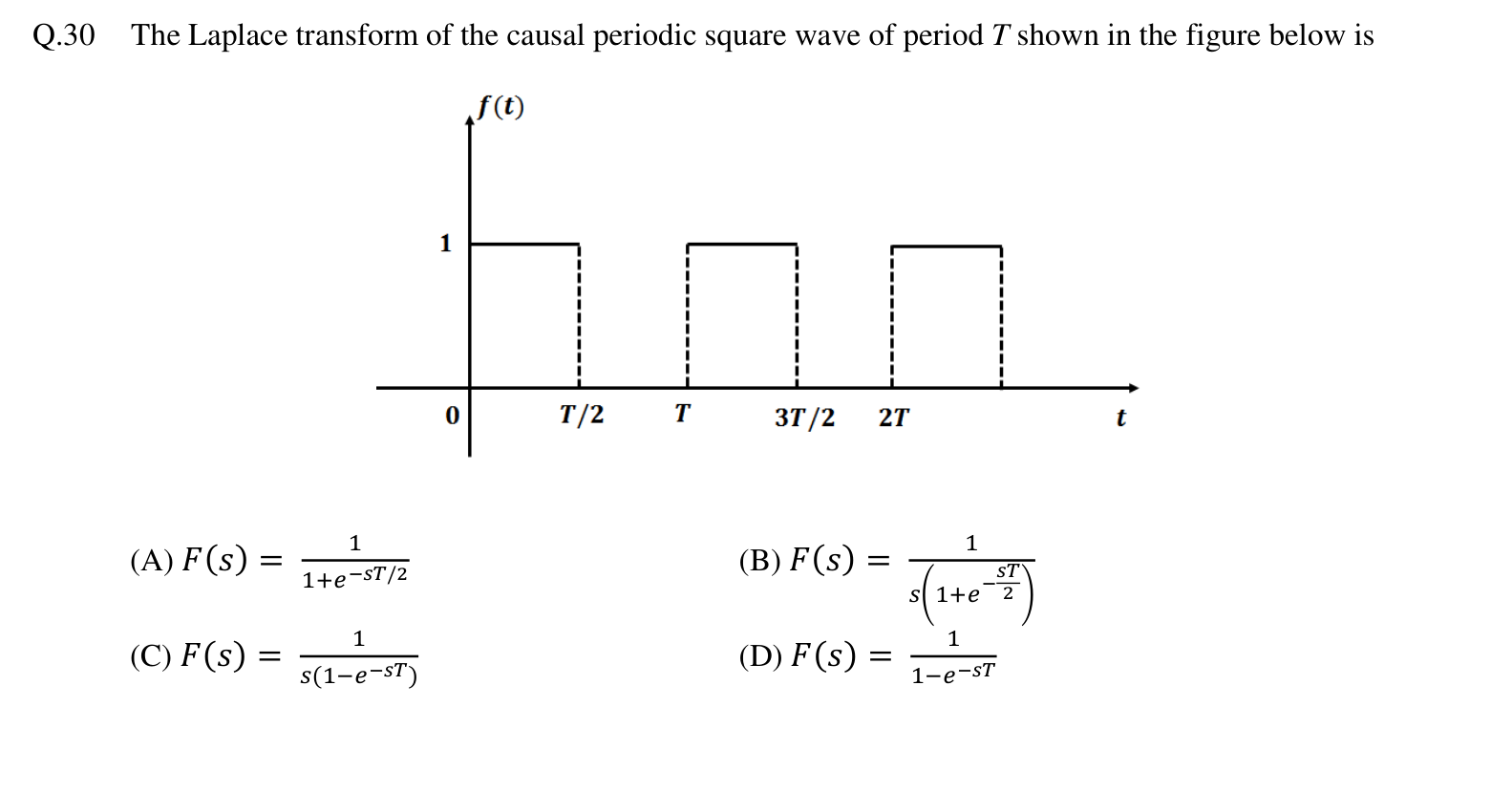
The Laplace transform of the causal periodic square wave of period $T$ shown in the figure below is
Practise this question in The GATE Grind →
Show answer and explanation
Correct answer: (B) $F(s) = \frac{1}{s\left(1 + e^{-\frac{sT}{2}}\right)}$
Explanation
For a causal periodic function, $F(s) = \frac{F_1(s)}{1 - e^{-sT}}$, where $F_1(s)$ is the transform of one period. One period is a pulse of height 1 for time $\frac{T}{2}$, so $F_1(s) = \frac{1 - e^{-sT/2}}{s}$. Using $1 - e^{-sT} = (1 - e^{-sT/2})(1 + e^{-sT/2})$, we get $F(s) = \frac{1}{s(1 + e^{-sT/2})}$.