GATE 2016 EC – Question 43
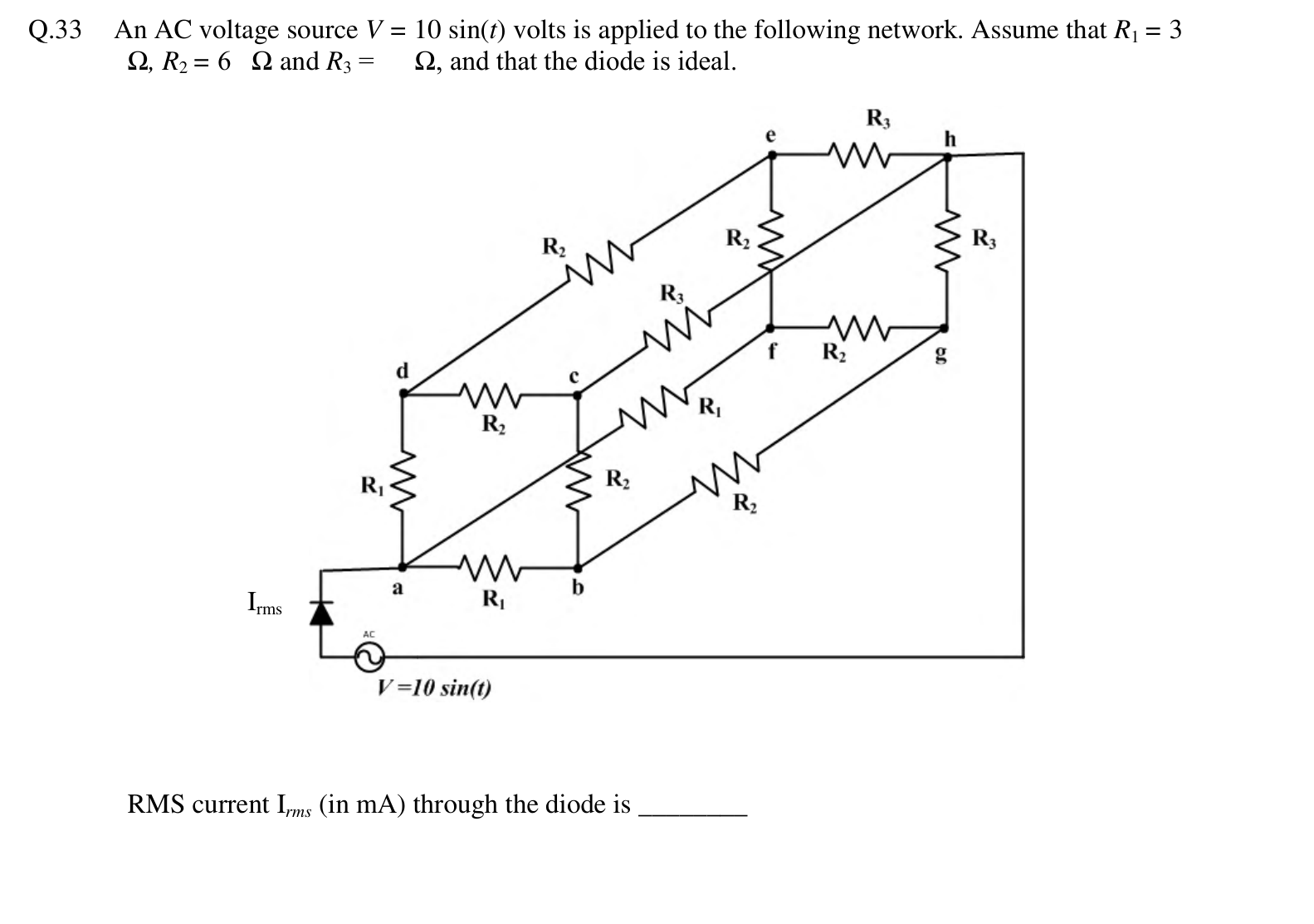
An AC voltage source $V = 10\sin(t)$ volts is applied to the following network. Assume that $R_1 = 3\ \text{k}\Omega$, $R_2 = 6\ \text{k}\Omega$ and $R_3 = 9\ \text{k}\Omega$, and that the diode is ideal.
[Figure: Eight nodes a, b, c, d, e, f, g, h joined by twelve resistors that form the edges of a cube. The three edges meeting at node a are $R_1$, the three edges meeting at node h are $R_3$, and the other six edges are $R_2$. The source and an ideal diode are connected in series between a and h.]
RMS current $I_{rms}$ (in mA) through the diode is ________
Practise this question in The GATE Grind →
Show answer and explanation
Correct answer: 0.9 to 1.1
Explanation
By symmetry, the three neighbours of node a (b, d, f) are at the same potential, and so are the three neighbours of node h (c, e, g). The resistance from a to h is $\frac{R_1}{3} + \frac{R_2}{6} + \frac{R_3}{3} = 1 + 1 + 3 = 5\ \text{k}\Omega$. The peak current is $\frac{10}{5\text{k}} = 2$ mA. The ideal diode lets only the positive half-cycles through, and the rms value of a half-wave rectified sine is half its peak, so $I_{rms} = 1$ mA.