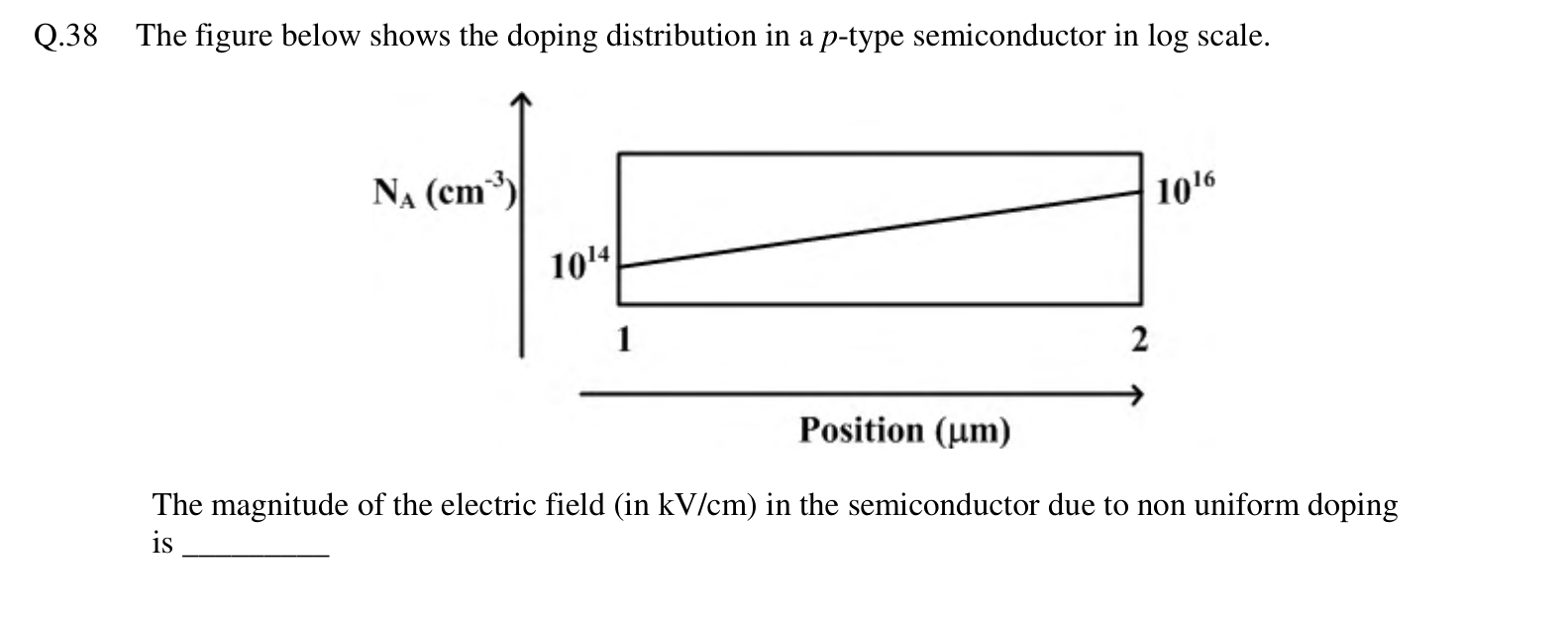
In equilibrium a nonuniform doping creates a field $E = \frac{kT}{q}\frac{d(\ln N_A)}{dx}$ (taking $kT/q = 26$ mV at 300 K). The doping increases by a factor of 100 over 1 μm, so $\frac{d(\ln N_A)}{dx} = \frac{\ln 100}{10^{-4}\text{ cm}} = 4.605 \times 10^4$ cm$^{-1}$. The field is $0.026 \times 4.605 \times 10^4 = 1197$ V/cm, which is about 1.2 kV/cm.
More Carrier Transport questions
GATE 2016 EC Q49– Consider a silicon sample at T = 300 K, with a uniform donor density N d = 5 1016 cm-3,…
GATE 2015 EC Q20– A silicon sample is uniformly doped with donor type impurities with a concentration of…
GATE 2015 EC Q45– For a silicon diode with long P and N regions, the accepter and donor impurity…
GATE 2017 EC Q46– The dependence of drift velocity of electrons on electric field in a semiconductor is…
GATE 2017 EC Q47– As shown, a uniformly doped Silicon (Si) bar of length L = 0.1\ m with a donor…
GATE 2014 EC (EC2) Q44– Given q=1.610-19 C, kT/q=25 mV and n=1000 cm²/(V·s), electrons injected into p-type…