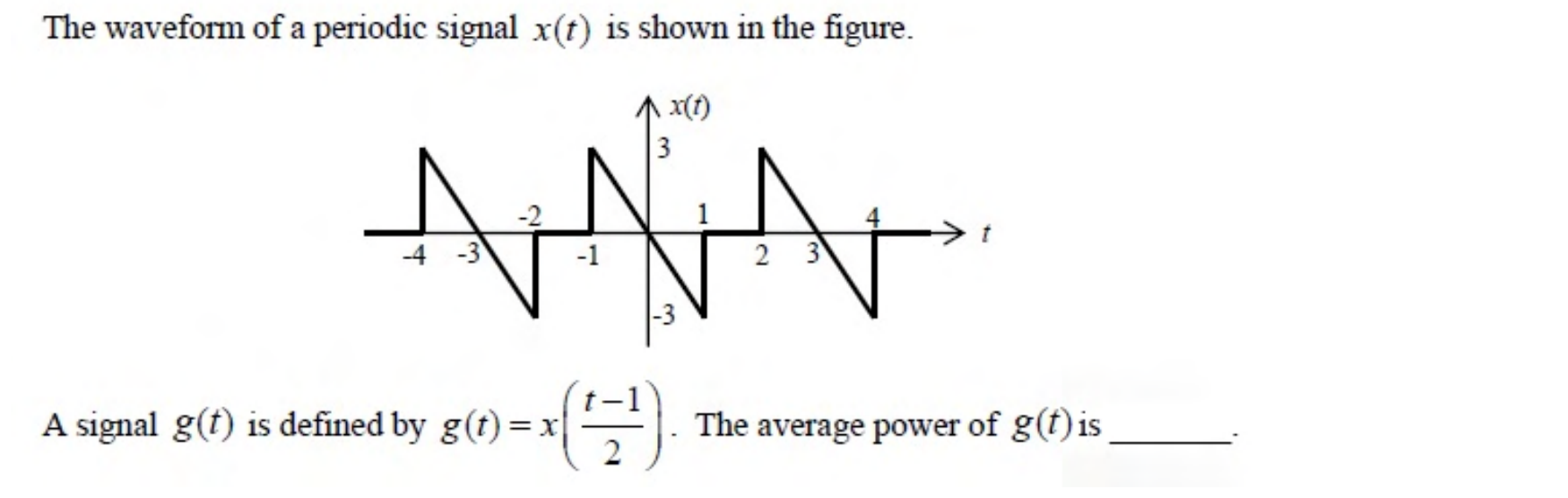
Shifting and stretching the time axis does not change the average power of a periodic signal. In one period of $x(t)$, the ramp from 3 to $-3$ over 2 s has the mean square value $\frac{1}{2}\int_0^2 \left(3 - 3t\right)^2 dt$, so the energy over the ramp is $\frac{3^2 \times 2}{3} = 6$. Dividing by the period 3 gives $\frac{6}{3} = 2$.
More Continuous-time Signals questions
GATE 2017 EC Q18– A periodic signal x(t) has a trigonometric Fourier series expansion x(t) = a 0 + n=1(a n n…
GATE 2017 EC Q41– Let x(t) be a continuous time periodic signal with fundamental period T = 1 seconds. Let…
GATE 2014 EC (EC1) Q28– Real signals x(t) and y(t) are band-limited to [−500,500] Hz and [−1,1] kHz, respectively.…
GATE 2014 EC (EC1) Q37– For every real , - g(t)e-j t\,dt= e-22. Let y(t)= -t g()\,d. Evaluate - y(t)\,dt.
GATE 2014 EC (EC1) Q42– The figure shows periodic x as a function of time. Find its rms value.
GATE 2014 EC (EC2) Q29– For the periodic square wave shown, find the approximate ratio of power in the seventh…