GATE 2015 EC – Question 51
The circuit shown in the figure has an ideal opamp. The oscillation frequency and the condition to sustain the oscillations, respectively, are
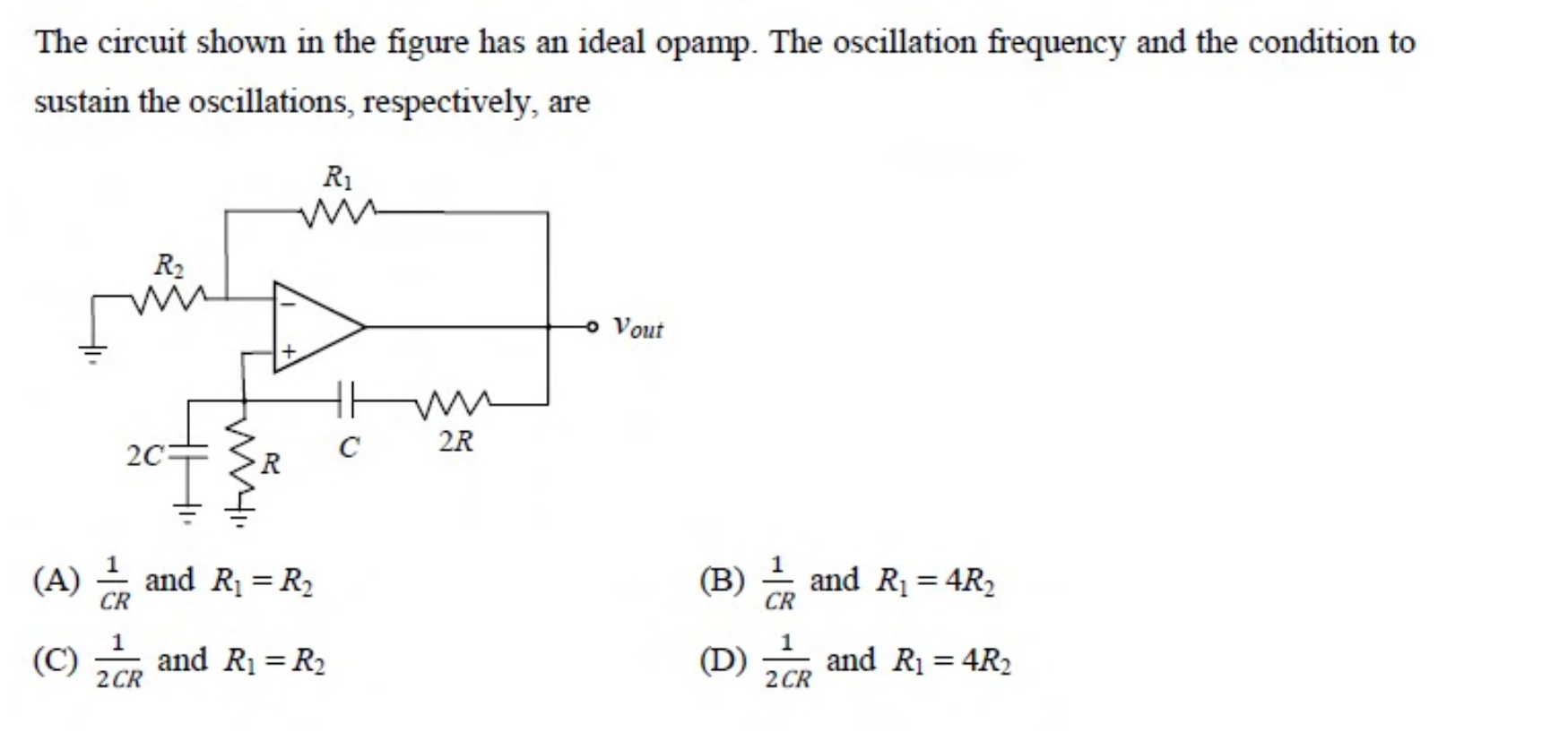
Practise this question in The GATE Grind →
Show answer and explanation
Correct answer: (D) $\frac{1}{2CR}$ and $R_1 = 4R_2$
Explanation
The positive-feedback network has a series arm $Z_1=2R+\frac{1}{sC}=\frac{1+2sRC}{sC}$ and a parallel arm $Z_2=\frac{R}{1+2sRC}$ (the $2C$ and $R$ in parallel). Its transfer function is
$$\beta=\frac{Z_2}{Z_1+Z_2}=\frac{sRC}{1+5sRC+4(sRC)^2}.$$
At $s=j\omega$ with $x=\omega RC$, $\beta=\dfrac{jx}{(1-4x^2)+5jx}$. The phase of $\beta$ is zero when $1-4x^2=0$, i.e. $\omega=\dfrac{1}{2RC}$, and then $\beta=\dfrac{j/2}{5j/2}=\dfrac15$.
The Barkhausen condition needs a gain of $1/\beta=5$ from the non-inverting amplifier, so $1+\dfrac{R_1}{R_2}=5$, i.e. $R_1=4R_2$.