GATE 2015 EC – Question 50
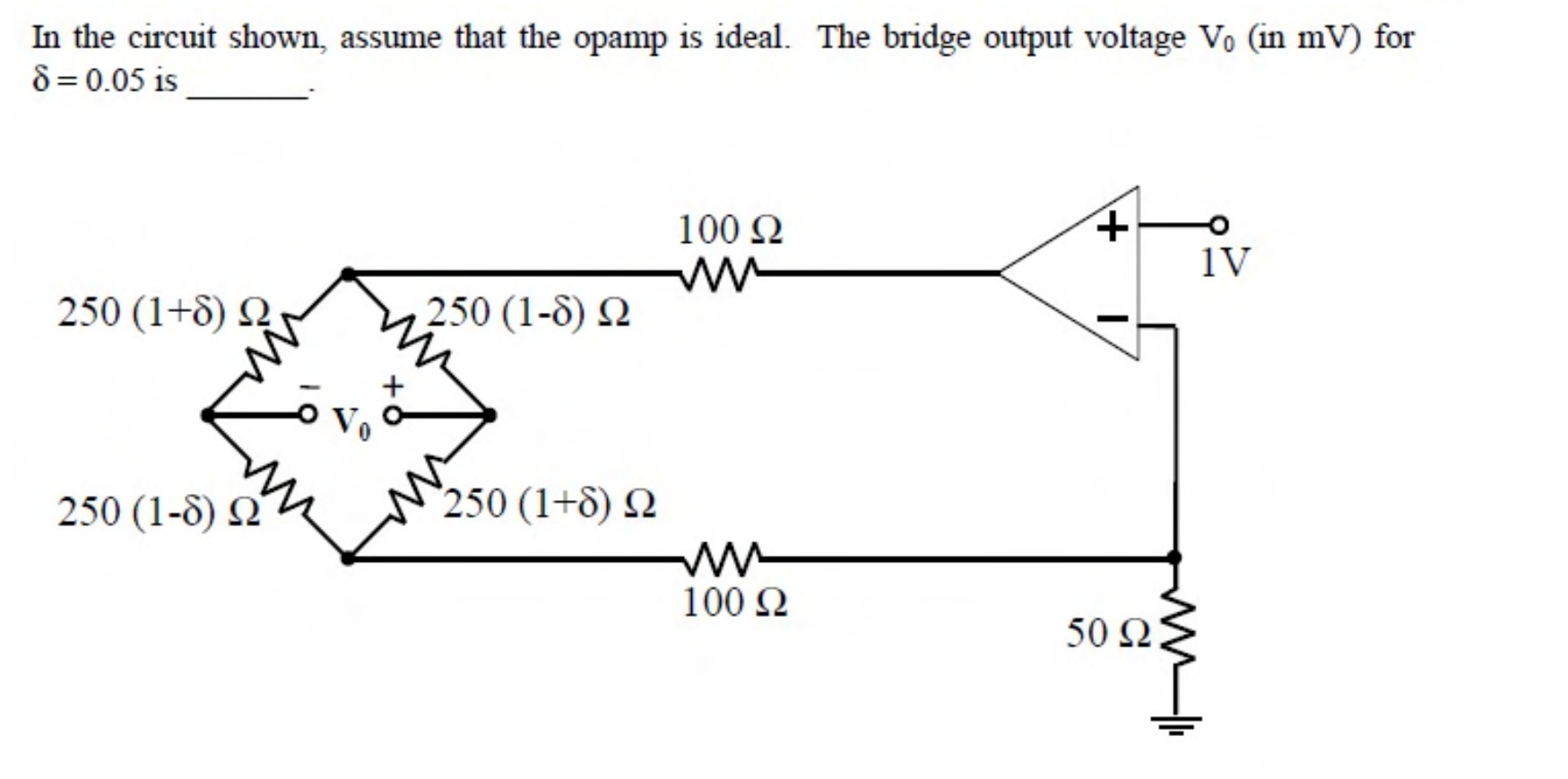
In the circuit shown, assume that the opamp is ideal. The bridge output voltage $V_0$ (in mV) for $\delta = 0.05$ is ________.
Practise this question in The GATE Grind →
Show answer and explanation
Correct answer: 249 to 251
Explanation
The op-amp forces 1 V across the $50\ \Omega$ resistor, so the current is $\frac{1}{50} = 20$ mA. This current flows through the bridge. Each bridge arm pair has $250(1 + \delta) + 250(1 - \delta) = 500\ \Omega$, so the two arms in parallel are $250\ \Omega$, and the voltage across the bridge is $20\ \text{mA} \times 250 = 5$ V. The bridge output is $V_0 = 5 \times \delta = 0.25$ V, which is 250 mV.