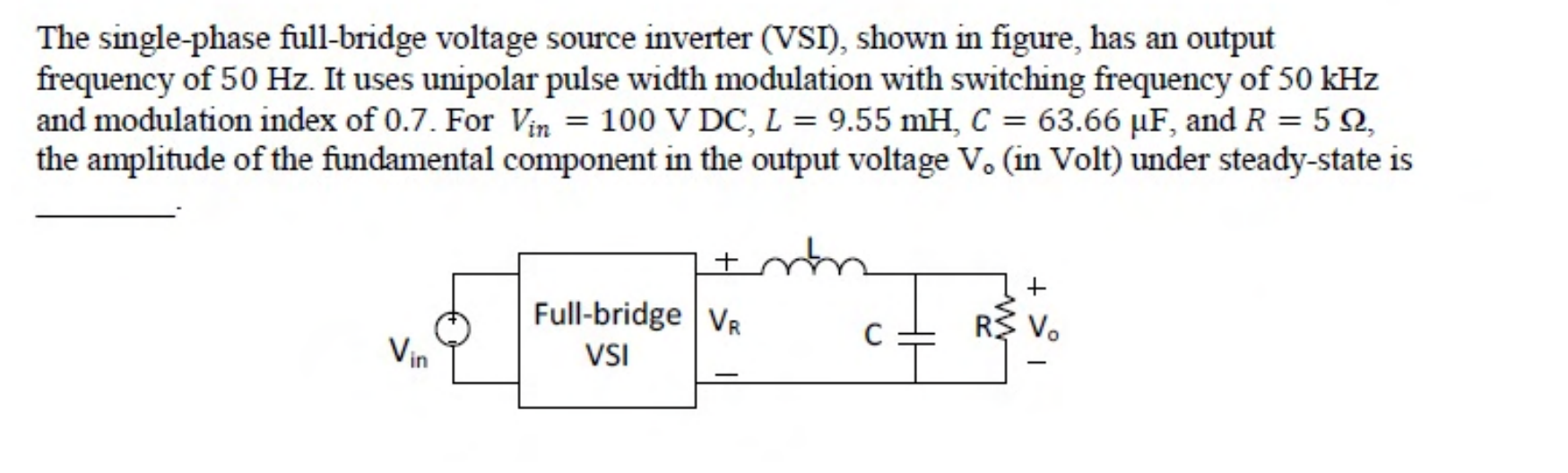
The single-phase full-bridge voltage source inverter (VSI), shown in figure, has an output frequency of 50 Hz. It uses unipolar pulse width modulation with switching frequency of 50 kHz and modulation index of 0.7. For $V_{in} = 100$ V DC, $L = 9.55$ mH, $C = 63.66\ \mu$F, and $R = 5\ \Omega$, the amplitude of the fundamental component in the output voltage $V_o$ (in Volt) under steady-state is ________.
The fundamental of the inverter output has an amplitude of $0.7 \times 100 = 70$ V. At 50 Hz, $X_L = 2\pi \times 50 \times 9.55 \times 10^{-3} = 3\ \Omega$ and the capacitor admittance is $\omega C = 0.02$ S. The parallel $R$ and $C$ have the admittance $0.2 + j0.02$, so their impedance is $4.96 - j0.5\ \Omega$ with magnitude 4.985. The total impedance is $4.96 + j2.5$, with magnitude 5.55. The output is $70 \times \frac{4.985}{5.55} = 62.9$ V.
More Single-phase and three-phase voltage and current source inverters, sinusoidal pulse width modulation questions
GATE 2017 EE Q34– In the converter circuit shown below, the switches are controlled such that the load…
GATE 2017 EE Q35– A 3-phase voltage source inverter is supplied from a 600 V DC source as shown in the…
GATE 2014 EE (EE1) Q65– The figure shows one period of inverter output. Choose 60° < α < 90° for…
GATE 2017 EE (EE2) Q23– A three-phase voltage-source inverter with ideal devices operates in 180° conduction mode…
GATE 2017 EE (EE2) Q49– A half-bridge voltage-source inverter feeds an RL load with R=40 Ω and L=0.3/ H.…
GATE 2016 EE (EE2) Q56– The three-phase VSI shown supplies a delta resistive load of 30 Ω per phase from 600 V DC.…