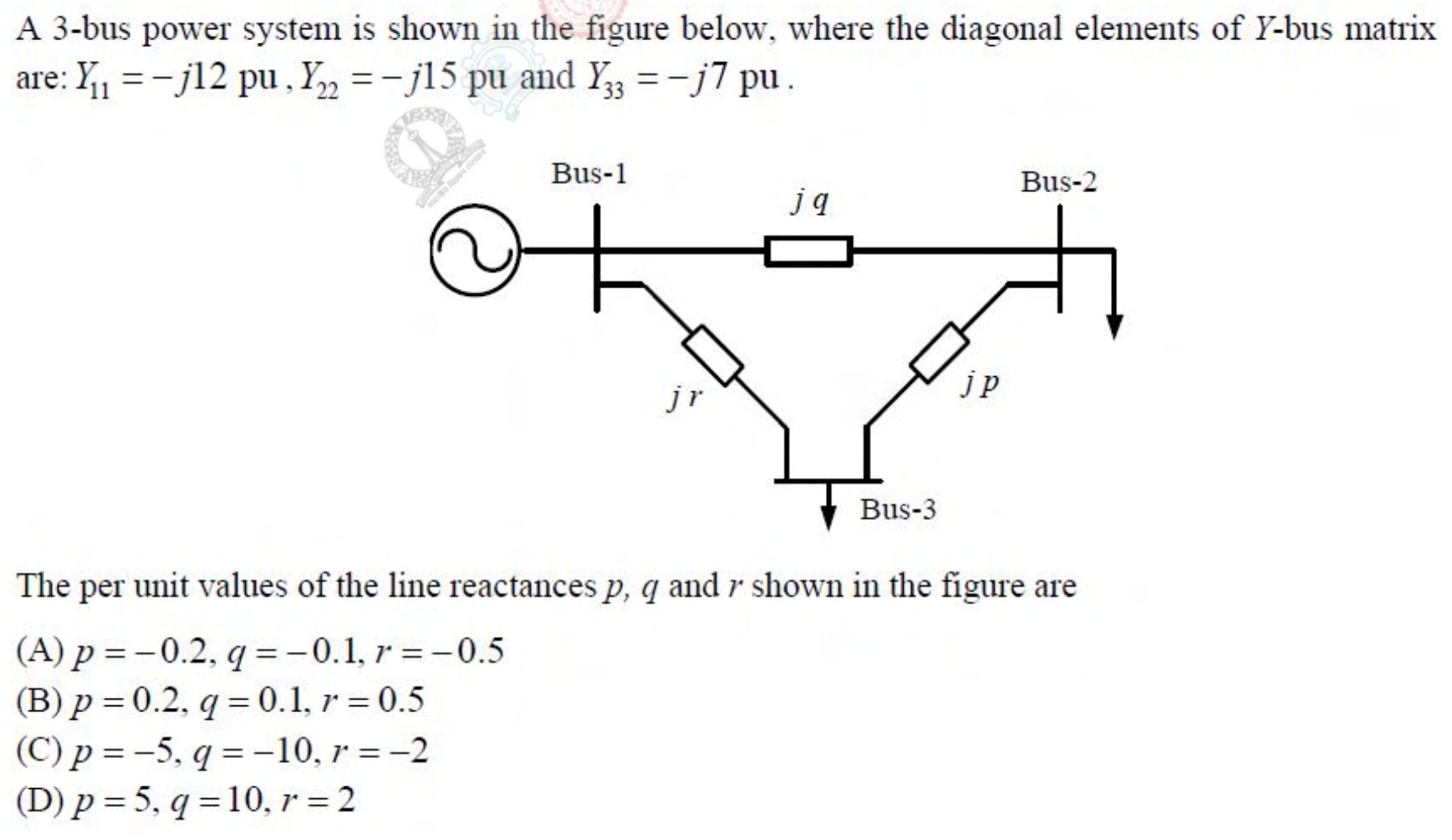
A 3-bus power system is shown in the figure below, where the diagonal elements of $Y$-bus matrix are: $Y_{11} = -j12$ pu, $Y_{22} = -j15$ pu and $Y_{33} = -j7$ pu.
The per unit values of the line reactances $p$, $q$ and $r$ shown in the figure are
Each diagonal element is the sum of the admittances of the lines at that bus, and a line of reactance $x$ has admittance $-j/x$. So $\frac{1}{q} + \frac{1}{r} = 12$, $\frac{1}{q} + \frac{1}{p} = 15$ and $\frac{1}{p} + \frac{1}{r} = 7$. Adding gives $\frac{1}{p} + \frac{1}{q} + \frac{1}{r} = 17$, so $\frac{1}{p} = 5$, $\frac{1}{r} = 2$ and $\frac{1}{q} = 10$. That gives $p = 0.2$, $q = 0.1$ and $r = 0.5$.
More Per-unit quantities, Bus admittance matrix, Gauss-Seidel and Newton-Raphson load flow methods questions
GATE 2017 EE Q31– A 10-bus power system consists of four generator buses indexed as G1, G2, G3, G4 and six…
GATE 2017 EE Q50– The bus admittance matrix for a power system network is bmatrix -j39.9 & j20 & j20 \\ j20…
GATE 2014 EE (EE1) Q51– The two-bus system shown supplies load 1.0 + j0.5 pu. Find V₁ (pu) and δ₂ respectively.
GATE 2014 EE (EE2) Q25– A three-phase star load operates at 0.9 pu voltage and 0.8 lagging power factor. Base…
GATE 2017 EE (EE2) Q25– The figure is a per-phase phase-shifting transformer between buses 1 and 2, with complex…
GATE 2017 EE (EE2) Q35– A polar-coordinate Newton–Raphson load-flow problem has a 100×100 Jacobian and 20 PV…