GATE 2017 EE – Question 19
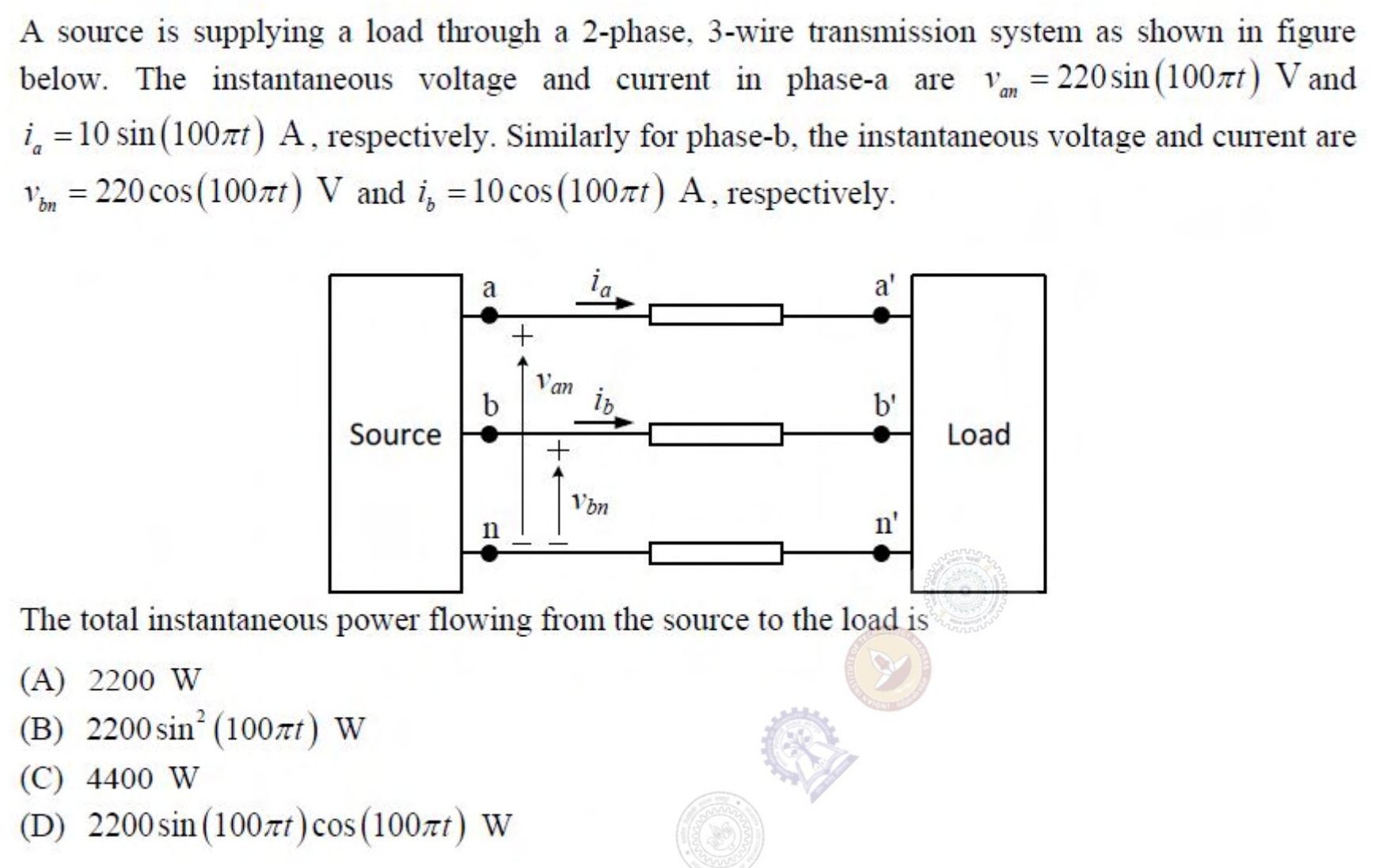
A source is supplying a load through a 2-phase, 3-wire transmission system as shown in figure below. The instantaneous voltage and current in phase-a are $v_{an} = 220\sin(100\pi t)$ V and $i_a = 10\sin(100\pi t)$ A, respectively. Similarly for phase-b, the instantaneous voltage and current are $v_{bn} = 220\cos(100\pi t)$ V and $i_b = 10\cos(100\pi t)$ A, respectively.
[Figure: A source connected to a load by three wires a, b and n. The currents $i_a$ and $i_b$ flow in wires a and b towards the load, and the voltages $v_{an}$ and $v_{bn}$ are measured from each of those wires to the neutral wire n.]
The total instantaneous power flowing from the source to the load is
Practise this question in The GATE Grind →
Show answer and explanation
Correct answer: (A) 2200 W
Explanation
The instantaneous power is the sum of the powers in the two phases: $p = v_{an}i_a + v_{bn}i_b = 2200\sin^2(100\pi t) + 2200\cos^2(100\pi t) = 2200$ W. The total power is constant at 2200 W.