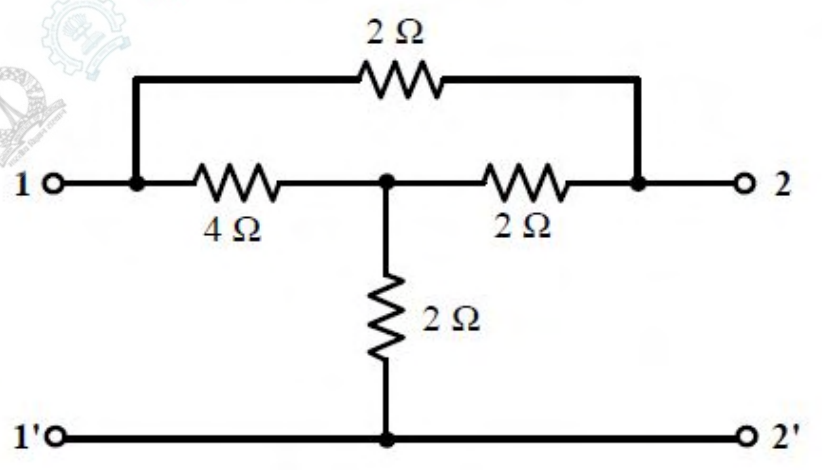
By definition, $z_{21}=V_2/I_1$ with the output port open, I2=0. The direct 4 Ω path from port 1 to the centre is parallel to the upper 2 Ω plus right 2 Ω path, also 4 Ω.
Input current divides equally between these paths and then all passes through the centre-to-ground 2 Ω resistor. The centre voltage is 2I1. The output is above it by $(I_1/2)(2)=I_1$.
Thus V2=3I1 and **$z_{21}=3\ \Omega$**.
More Transient response of DC and AC networks, sinusoidal steady-state analysis, resonance, two port networks, balanced three phase circuits, star-delta transformation, complex power and power factor in AC circuits questions
GATE 2017 EE (EE2) Q39– A balanced Y–Y connected three-phase circuit has line-to-line rms voltage 208 V. The load…
GATE 2016 EE (EE2) Q22– Load voltage and current are v(t)=100 t V and i(t)=10( t-60)+23 t+55 t A. Average load…
GATE 2016 EE (EE2) Q45– The shown two-port has z11=40 Ω,z12=60 Ω,z21=80 Ω,z22=100 Ω. Find average power delivered…
GATE 2016 EE (EE2) Q46– In the balanced three-phase 50 Hz circuit, each delta inductor has L=10 mH. Find each star…
GATE 2015 EE (EE2) Q54– The circuit has V 1=1000 V, V 2=100-120 V, V 3=100120 V. Find phasor current i in amperes.
GATE 2015 EE (EE2) Q55– A symmetric ±15 V square wave of 50% duty and period 0.4π ms drives series RLC with R=5…