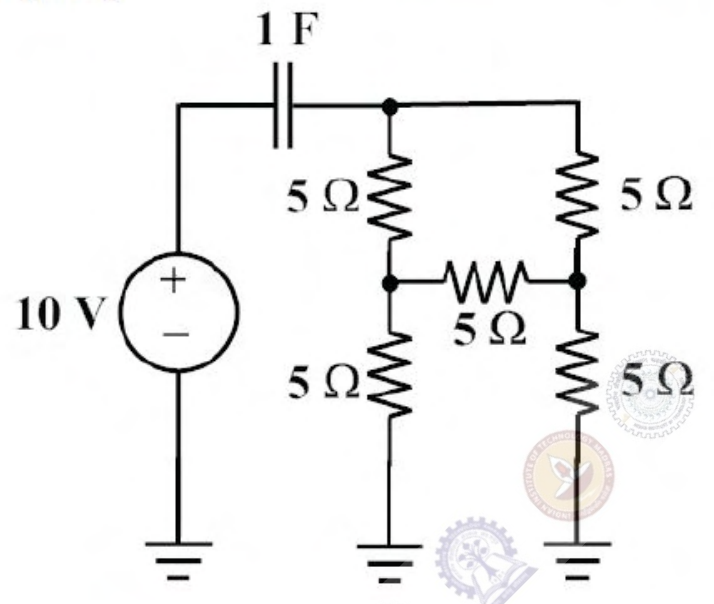
The 1 F capacitor in the circuit is initially uncharged. The energy transferred from the 10 V DC source until steady state, in joules to one decimal place, is ________.
The symmetric resistor bridge provides a finite path from the capacitor's right plate to ground; its middle resistor has no voltage across it. At final DC steady state no current flows, so the right plate is at ground and the capacitor voltage is 10 V.
Charge supplied by the source is ΔQ=CV=1×10=10 C. Source energy is $V\Delta Q=10(10)=$ **100.0 J**. Half remains in the capacitor; half is dissipated in resistors, so using only stored energy would undercount the source transfer.
More Network Elements: Ideal voltage and current sources, dependent sources, R, L, C, M elements questions
GATE 2016 EE (EE2) Q47– The capacitor initially has 4 V. S1 closes at t=0. The charge lost between t=25 μs and…
GATE 2015 EE (EE2) Q28– The series RL circuit has zero initial conditions and a DC source V switched on at t=0.…
GATE 2026 EE Q23– A circuit with ideal elements is shown. Which one of the following options correctly…
GATE 2026 EE Q25– Refer to the four circuits shown. Which one of the following options for k 1, k 2, k 3,…
GATE 2025 EE Q18– The I-V characteristics of the element between the nodes X and Y is best depicted by
GATE 2025 EE Q19– A nullator is defined as a circuit element where the voltage across the device and the…