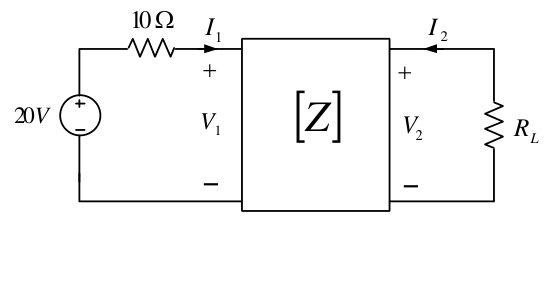
With port currents defined entering the two-port, V2=−20I2. The z equation gives $80I_1+100I_2=-20I_2$, so I2=−(2/3)I1.
At the input, the 20 V source and 10 Ω resistor give $20=10I_1+V_1=50I_1+60I_2$. Substitution gives I1=2 A and I2=−4/3 A.
The load power is $I_2^2R_L=(16/9)20=$ **35.5556 W**, within 34–36 W.
More Transient response of DC and AC networks, sinusoidal steady-state analysis, resonance, two port networks, balanced three phase circuits, star-delta transformation, complex power and power factor in AC circuits questions
GATE 2016 EE (EE2) Q46– In the balanced three-phase 50 Hz circuit, each delta inductor has L=10 mH. Find each star…
GATE 2015 EE (EE2) Q54– The circuit has V 1=1000 V, V 2=100-120 V, V 3=100120 V. Find phasor current i in amperes.
GATE 2015 EE (EE2) Q55– A symmetric ±15 V square wave of 50% duty and period 0.4π ms drives series RLC with R=5…
GATE 2026 EE Q26– A single-phase voltage source v s=325(250t) V delivers a current, i=12(250t)+9(2150t) A to…
GATE 2026 EE Q42– An electrical component has voltage drop v=V m( t), when the current through it is i=I m(…
GATE 2026 EE Q43– The electrical network shown has an independent voltage source (10 V) and a current source…