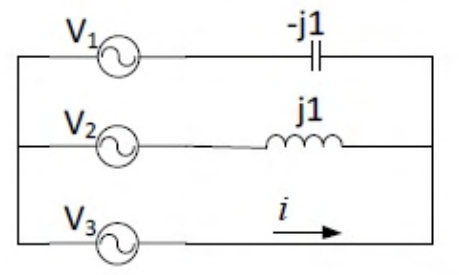
Use the bottom source V3 to fix the common terminal voltage. The upper branch current is (V1−V3)/(−j) and the middle current is (V2−V3)/j.
KCL gives the indicated bottom current as the negative of their sum: i=−j(V1−V2). Since V1−V2=150+j86.6025, i=86.6025−j150.
Its magnitude and angle are **173.205 A and −60°, A**.
More Transient response of DC and AC networks, sinusoidal steady-state analysis, resonance, two port networks, balanced three phase circuits, star-delta transformation, complex power and power factor in AC circuits questions
GATE 2015 EE (EE2) Q55– A symmetric ±15 V square wave of 50% duty and period 0.4π ms drives series RLC with R=5…
GATE 2026 EE Q26– A single-phase voltage source v s=325(250t) V delivers a current, i=12(250t)+9(2150t) A to…
GATE 2026 EE Q42– An electrical component has voltage drop v=V m( t), when the current through it is i=I m(…
GATE 2026 EE Q43– The electrical network shown has an independent voltage source (10 V) and a current source…
GATE 2025 EE Q57– The switch (S) closes at t=0 sec. The time, in sec, the capacitor takes to charge to 50 V…
GATE 2024 EE Q14– The circuit shown in the figure with the switch S open, is in steady state. After the…