GATE 2017 EE – Question 41
Let the signal
$$x(t) = \sum_{k=-\infty}^{+\infty}(-1)^k\delta\left(t - \frac{k}{2000}\right)$$
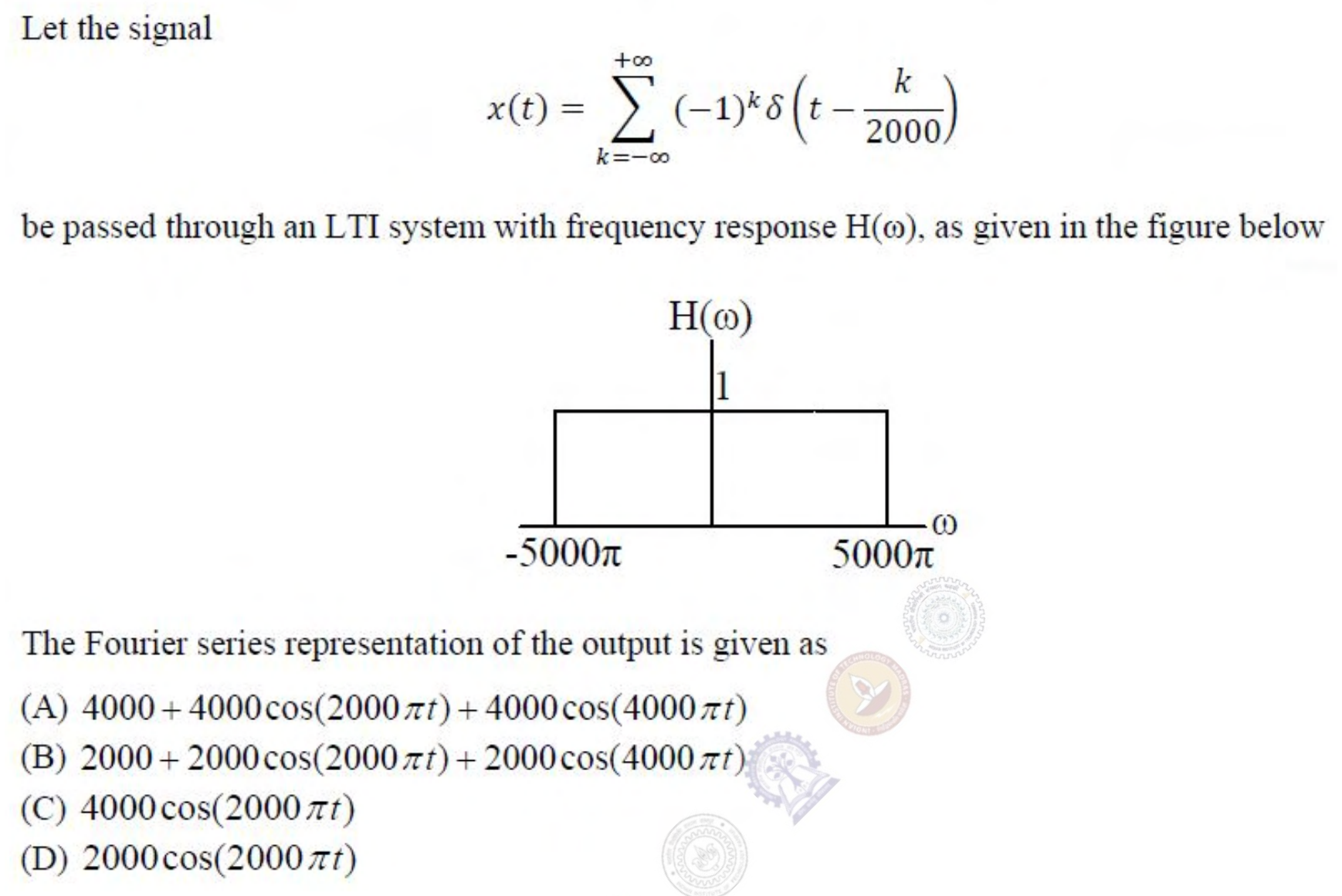
be passed through an LTI system with frequency response $H(\omega)$, as given in the figure below.
[Figure: $H(\omega)$ is an ideal low-pass filter with gain 1 for $|\omega| \leq 5000\pi$ and 0 outside.]
The Fourier series representation of the output is given as
Practise this question in The GATE Grind →
Show answer and explanation
Correct answer: (C) $4000\cos(2000\pi t)$
Explanation
The impulses alternate in sign every $\frac{1}{2000}$ s, so the signal has period $\frac{1}{1000}$ s, with a $+1$ impulse at 0 and a $-1$ impulse at $\frac{1}{2000}$ s. The Fourier coefficients are $c_n = 1000\left(1 - (-1)^n\right)$, which is 2000 for odd $n$ and 0 for even $n$. The fundamental is at $2000\pi$ rad/s, and the next nonzero harmonic, $n = 3$ at $6000\pi$, is above the filter cutoff $5000\pi$. Only $n = \pm 1$ survive, giving $2 \times 2000\cos(2000\pi t) = 4000\cos(2000\pi t)$.