The GATE Grind

GATE 2017 EE – Question 42

Control Systems · Mathematical modelling and representation of systems, Feedback principle, Transfer function, Block diagrams and Signal flow graphs · 2 marks · Multiple choice

In the system whose signal flow graph is shown in the figure, $U_1(s)$ and $U_2(s)$ are inputs. The transfer function $\dfrac{Y(s)}{U_1(s)}$ is
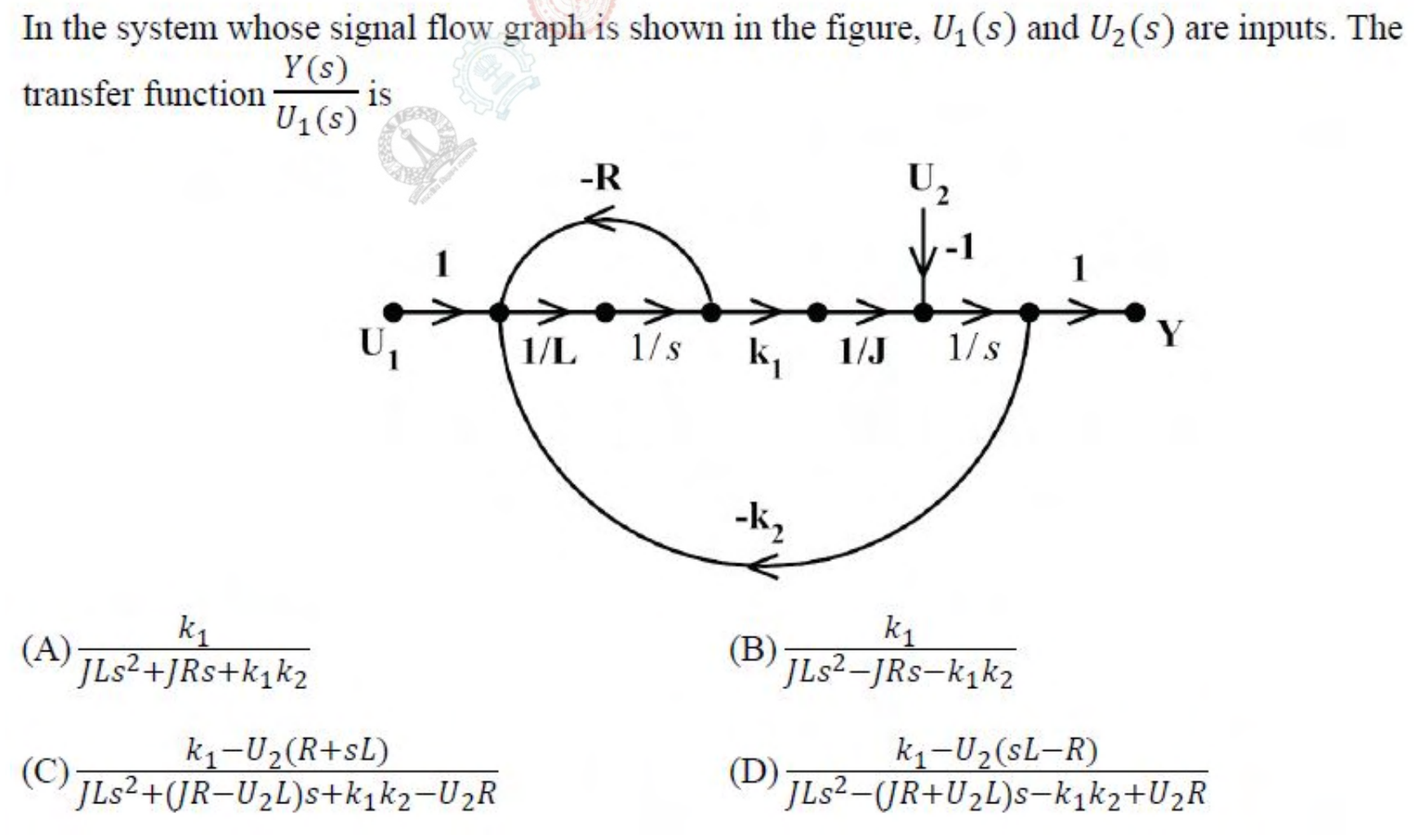
A signal flow graph. The forward path from $U_1$ goes through gains $1$, $\frac{1}{L}$, $\frac{1}{s}$, $k_1$, $\frac{1}{J}$ and $\frac{1}{s}$ to $Y$. A feedback path with gain $-R$ returns across the first $\frac{1}{L}$ and $\frac{1}{s}$ sections, and a second feedback path with gain $-k_2$ returns across the whole forward path. The input $U_2$ joins with gain $-1$ before the last section.
  1. $\dfrac{k_1}{JLs^2 + JRs + k_1k_2}$
  2. $\dfrac{k_1}{JLs^2 - JRs - k_1k_2}$
  3. $\dfrac{k_1 - U_2(R + sL)}{JLs^2 + (JR - U_2L)s + k_1k_2 - U_2R}$
  4. $\dfrac{k_1 - U_2(sL - R)}{JLs^2 - (JR + U_2L)s - k_1k_2 + U_2R}$

Practise this question in The GATE Grind →

Show answer and explanation

Correct answer: (A) $\dfrac{k_1}{JLs^2 + JRs + k_1k_2}$

Explanation

The only forward path from $U_1$ to $Y$ has gain $\frac{k_1}{JLs^2}$. There are two loops: $-\frac{R}{Ls}$ and $-\frac{k_1k_2}{JLs^2}$, and both touch the forward path. So $\Delta = 1 + \frac{R}{Ls} + \frac{k_1k_2}{JLs^2}$ and $\frac{Y}{U_1} = \frac{k_1/(JLs^2)}{\Delta} = \frac{k_1}{JLs^2 + JRs + k_1k_2}$.