GATE 2026 CE (CE1) – Question 38
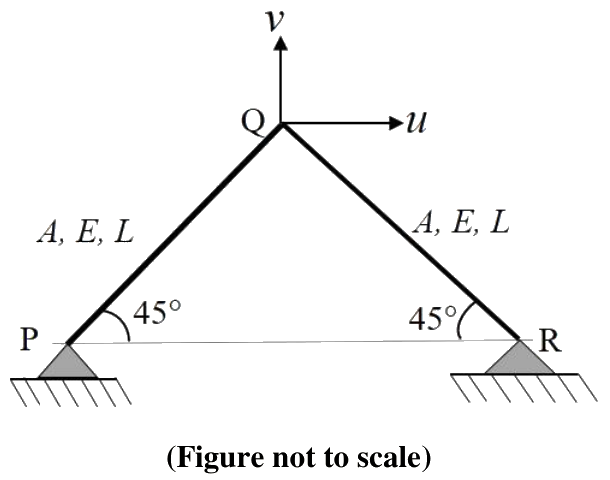
A plane truss consists of two linearly elastic, homogeneous, identical members, namely PQ and QR. Both members have length ($L$), cross-sectional area ($A$), and modulus of elasticity ($E$). The members are inclined at 45° as shown in the figure. The truss has hinge supports at P and R. The translational degrees-of-freedom ($u$ and $v$) are shown at joint Q.
After application of the boundary conditions, the stiffness matrix of the truss becomes:
Practise this question in The GATE Grind →
Show answer and explanation
Correct answer: (C) $\frac{AE}{L}\begin{bmatrix} 1 & 0 \\ 0 & 1 \end{bmatrix}$
Explanation
A member at angle $\theta$ adds $\frac{AE}{L}\begin{bmatrix} c^2 & cs \\ cs & s^2 \end{bmatrix}$ to the stiffness at Q. With $c = s = \frac{1}{\sqrt{2}}$, each member gives $\frac{AE}{L}\begin{bmatrix} 0.5 & \pm 0.5 \\ \pm 0.5 & 0.5 \end{bmatrix}$. The off-diagonal terms have opposite signs for the two members, because they lean in opposite directions, so they cancel. The sum is $\frac{AE}{L}\begin{bmatrix} 1 & 0 \\ 0 & 1 \end{bmatrix}$.