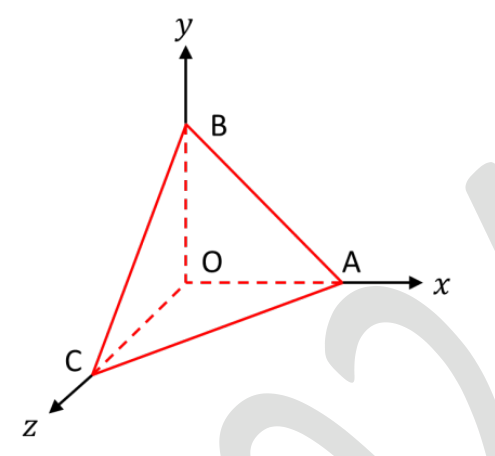
A rigid massless tetrahedron is placed such that vertex O is at the origin and the other three vertices A, B, and C lie on the coordinate axes as shown in the figure. The body is acted on by three point loads, of which one is acting at A along $x$-axis and another at point B along $y$-axis. For the body to be in equilibrium, the third point load acting at point O must be
Correct answer: (B) in $x-y$ plane but not along $x$ or $y$ axis
Explanation
A is on the $x$-axis, so the load at A along the $x$-axis acts along the line OA and passes through O. In the same way the load at B along the $y$-axis acts along OB and passes through O. The two forces meet at O and add up to a resultant at O that lies in the $x-y$ plane. The load at O has to cancel it, so it also lies in the $x-y$ plane, and in general it is not along the $x$ or the $y$ axis.
More Free-body diagrams and equilibrium questions
GATE 2022 ME (ME2) Q26– A square plate is supported in four different ways (configurations (P) to (S) as shown in…
GATE 2021 ME (ME1) Q60– Two smooth identical spheres each of radius 125 mm and weight 100 N rest in a horizontal…
GATE 2020 ME (ME2) Q15– A roller of weight W is pulled over a curb by a horizontal force F as shown. Static…
GATE 2020 ME (ME2) Q30– A negligible-mass beam is hinged at P and roller-supported at Q as shown. A 1200 N…
GATE 2018 ME (ME1) Q15– A uniform bar weighing 100 N is held horizontally by massless inextensible strings S1 and…
GATE 2016 ME (ME1) Q16– A rigid ball of weight 100 N is suspended with the help of a string. The ball is pulled by…