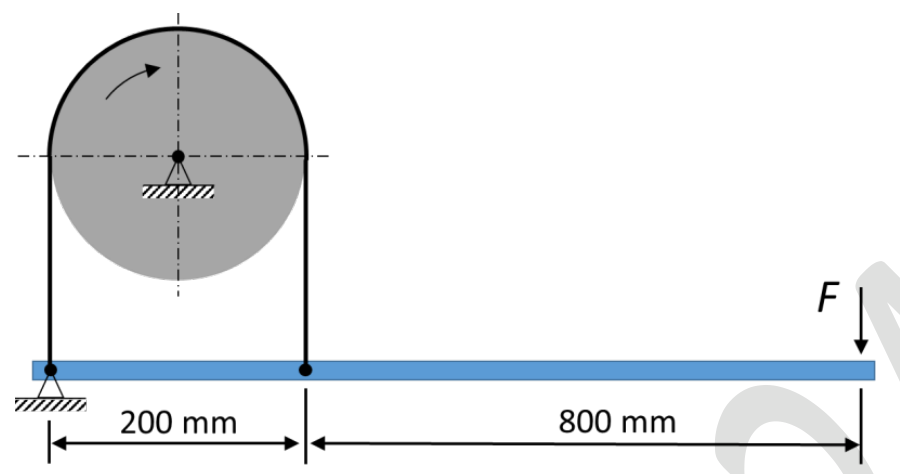
A band brake shown in the figure has a coefficient of friction of 0.3. The band can take a maximum force of 1.5 kN. The maximum braking force ($F$) that can be safely applied is _______ N (*rounded off to the nearest integer*).
The drum turns clockwise, so it drags the band down on its right side and that side carries the larger (tight side) tension $T_1$. The right end of the band is joined to the lever 200 mm from the pivot, and the slack side is joined at the pivot, so its tension gives no moment there. Moments about the pivot: $F \times 1000 = T_1 \times 200$, so $F = 0.2T_1$. The band can take 1500 N at most, so $F_{max} = 0.2 \times 1500 = 300$ N.
More Brakes and clutches questions
GATE 2021 ME (ME1) Q63– A short shoe drum (radius 260 mm) brake is shown in the figure. A force of 1 kN is applied…
GATE 2020 ME (ME1) Q47– A disc-type axial clutch has annular contact with outer and inner diameters 250 and 50 mm.…
GATE 2019 ME (ME1) Q54– The shown single-block short-shoe brake has torque capacity 250 N·m. Its cylindrical drum…
GATE 2019 ME (ME2) Q52– The shown short-shoe external drum brake has drum diameter 500 mm and dimensions a = 1000…
GATE 2018 ME (ME1) Q63– The clockwise external drum shown engages a short shoe at Y on rigid lever XYZ, hinged at…
GATE 2016 ME (ME2) Q22– For the brake shown in the figure, which one of the following is TRUE?