GATE 2025 CH – Question 25
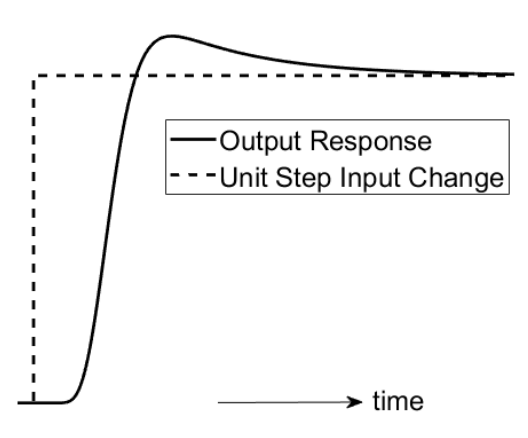
Choose the transfer function that best fits the output response to a unit step input change shown in the figure
Practise this question in The GATE Grind →
Show answer and explanation
Correct answer: (A) $\frac{(\alpha s + 1)e^{-\theta s}}{(\tau_1 s + 1)(\tau_2 s + 1)^2}$
Explanation
Three features can be read from the curve. First, there is a flat start, which needs a dead time $e^{-\theta s}$, so option C (no delay) is out. Second, after the dead time the response starts with zero slope and then bends upward (an S-shape), which needs a transfer function with the denominator at least two orders higher than the numerator. Option B has a difference of only one, so its response would start with a non-zero slope. Third, the output overshoots the final value, which needs a lead term $(\alpha s + 1)$ in the numerator. Option D has two numerator zeros that make the difference one again. Option A, with one lead term, a third-order denominator and a dead time, matches all three features.