GATE 2025 CH – Question 39
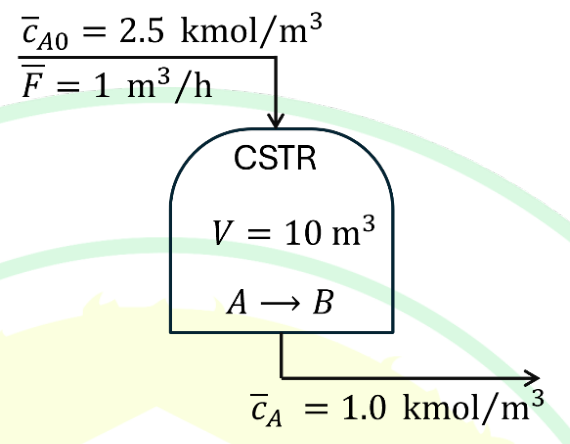
The first-order irreversible liquid phase reaction $A \longrightarrow B$ occurs inside a constant volume ($V$) isothermal CSTR with the initial steady state conditions shown in the figure. The gain, in $\frac{\text{kmol/m}^3}{\text{m}^3/\text{h}}$, of the transfer function relating the reactor effluent $A$ concentration, $c_A$, to the inlet flow rate, $F$, is
Practise this question in The GATE Grind →
Show answer and explanation
Correct answer: (C) 0.6
Explanation
At steady state $\bar{F}(\bar{c}_{A0} - \bar{c}_A) = kV\bar{c}_A$, so $1 \times 1.5 = k \times 10 \times 1$ and $k = 0.15$ h$^{-1}$. The dynamic balance is $V\frac{dc_A}{dt} = F(c_{A0} - c_A) - kVc_A$. Linearising and taking deviations: $V\frac{dc_A'}{dt} = (\bar{c}_{A0} - \bar{c}_A)F' - (\bar{F} + kV)c_A'$. The gain is $K = \frac{\bar{c}_{A0} - \bar{c}_A}{\bar{F} + kV} = \frac{1.5}{1 + 1.5} = 0.6$.