GATE 2025 CH – Question 41
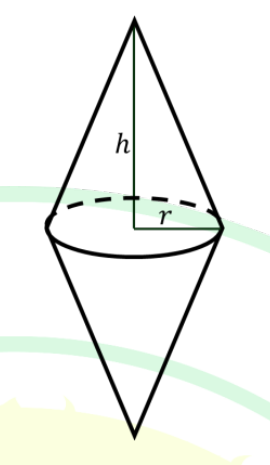
A catalyst particle is modeled as a symmetrical double cone solid as shown in the figure. For each conical sub-part, the radius of the base is $r$ and the height is $h$. The sphericity of the particle is given by
Practise this question in The GATE Grind →
Show answer and explanation
Correct answer: (C) $\frac{2\left(\frac{r^2h}{2}\right)^{2/3}}{r\sqrt{r^2 + h^2}}$
Explanation
Sphericity is the surface area of the sphere that has the same volume as the particle, divided by the surface area of the particle. The volume of the double cone is $V = 2 \times \frac{1}{3}\pi r^2h = \frac{2}{3}\pi r^2h$. A sphere of radius $R$ with this volume has $\frac{4}{3}\pi R^3 = \frac{2}{3}\pi r^2h$, so $R^3 = \frac{r^2h}{2}$ and its area is $4\pi R^2 = 4\pi\left(\frac{r^2h}{2}\right)^{2/3}$. The particle has two curved cone surfaces, each $\pi r\sqrt{r^2 + h^2}$, so its area is $2\pi r\sqrt{r^2 + h^2}$. The sphericity is $\frac{4\pi(r^2h/2)^{2/3}}{2\pi r\sqrt{r^2 + h^2}} = \frac{2(r^2h/2)^{2/3}}{r\sqrt{r^2 + h^2}}$.