GATE 2025 CH – Question 48
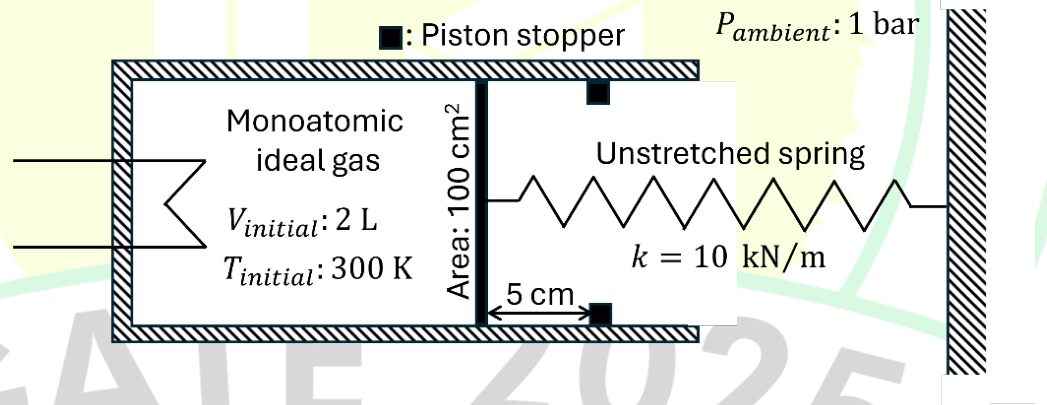
An ideal monoatomic gas is contained inside a cylinder-piston assembly connected to a Hookean spring as shown in the figure. The piston is frictionless and massless. The spring constant is 10 kN/m. At the initial equilibrium state (shown in the figure), the spring is unstretched. The gas is expanded reversibly by adding 362.5 J of heat. At the final equilibrium state, the piston presses against the stoppers. Neglecting the heat loss to the surroundings, the final equilibrium temperature of the gas is ____ K (rounded off to the nearest integer).
GIVEN: For a monoatomic ideal gas, $C_v = \frac{3}{2}R$, where $R = 8.314$ J/(mol K)
Practise this question in The GATE Grind →
Show answer and explanation
Correct answer: 600
Explanation
The initial pressure equals the ambient pressure (the spring is unstretched), 1 bar, so $n = \frac{PV}{RT} = \frac{10^5 \times 2 \times 10^{-3}}{8.314 \times 300} = 0.0802$ mol and $nC_v = \frac{3}{2}\frac{PV}{T} = \frac{1.5 \times 200}{300} = 1.0$ J/K. The piston moves 5 cm, a volume change of $0.01 \times 0.05 = 5 \times 10^{-4}$ m$^3$. The work done by the gas goes into pushing the atmosphere back and stretching the spring: $W = P_{amb}\Delta V + \frac{1}{2}kx^2 = 10^5 \times 5 \times 10^{-4} + \frac{1}{2} \times 10^4 \times 0.05^2 = 50 + 12.5 = 62.5$ J. The first law gives $\Delta U = Q - W = 362.5 - 62.5 = 300$ J, so $\Delta T = \frac{300}{1.0} = 300$ K and the final temperature is $T = 300 + 300 = 600$ K. (After the piston reaches the stoppers the gas is heated at constant volume, and the final pressure of about 1.6 bar is higher than the 1.5 bar needed to balance the spring, which is consistent.)