GATE 2025 CH – Question 64
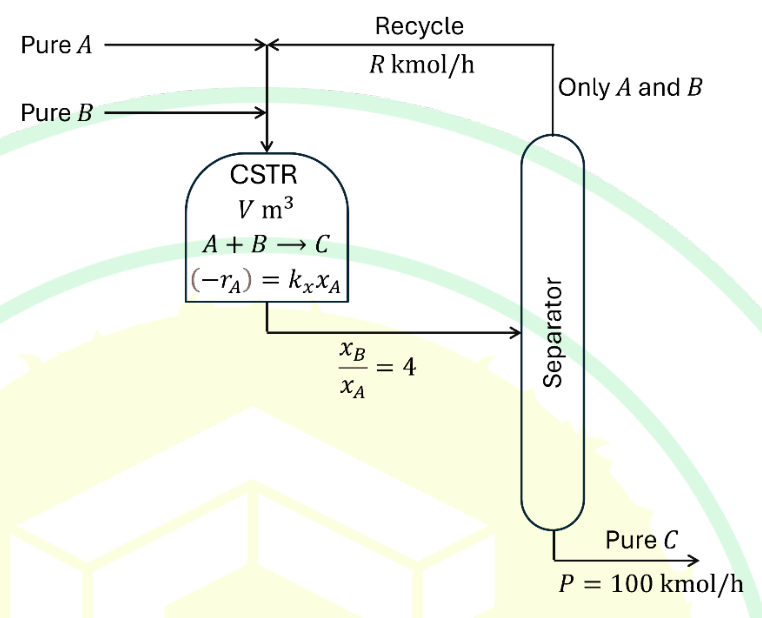
Consider the flowsheet in the figure for manufacturing $C$ via the reaction $A + B \longrightarrow C$ in an isothermal CSTR. The split in the separator is perfect so that the recycle stream is free of $C$ and the product stream is pure $C$. Let $x_i$ denote the mole fraction of species $i$ ($i = A, B, C$) in the CSTR, which is operated in excess $B$ with $x_B/x_A = 4$. The reaction is first-order in $A$ with the reaction rate $(-r_A) = k_xx_A$, where $k_x = 5.0$ kmol/(m$^3$ h).
The reactor volume $V$ in m$^3$ is to be optimized to minimize the cost objective $J = V + 0.25R$, where $R$ is the recycle rate in kmol/h. For a product rate $P = 100$ kmol/h, the optimum value of $V$ is ____ m$^3$ (rounded off to the nearest integer).
GIVEN: $\frac{d}{dz}\left(\frac{z}{1 - z}\right) = \frac{1}{(1 - z)^2}$
Practise this question in The GATE Grind →
Show answer and explanation
Correct answer: 150
Explanation
For 100 kmol/h of C produced, 100 kmol/h of A is consumed in the reactor. The separator is perfect, so the recycle has the same A:B ratio as the reactor, 1:4, with $R/5$ of A and $4R/5$ of B. The reactor effluent has $R/5$ of A, $4R/5$ of B and 100 of C, a total of $R + 100$ kmol/h, so $x_A = \frac{R/5}{R + 100}$. The CSTR balance on A is $100 = k_xx_AV$, so $V = \frac{100}{5x_A} = \frac{20(R + 100)}{R/5} = 100\left(1 + \frac{100}{R}\right)$. The cost is $J = 100 + \frac{10000}{R} + 0.25R$. Setting $\frac{dJ}{dR} = -\frac{10000}{R^2} + 0.25 = 0$ gives $R^2 = 40000$, $R = 200$ kmol/h, and then $V = 100 \times 1.5 = 150$ m$^3$.