GATE 2023 CH – Question 60
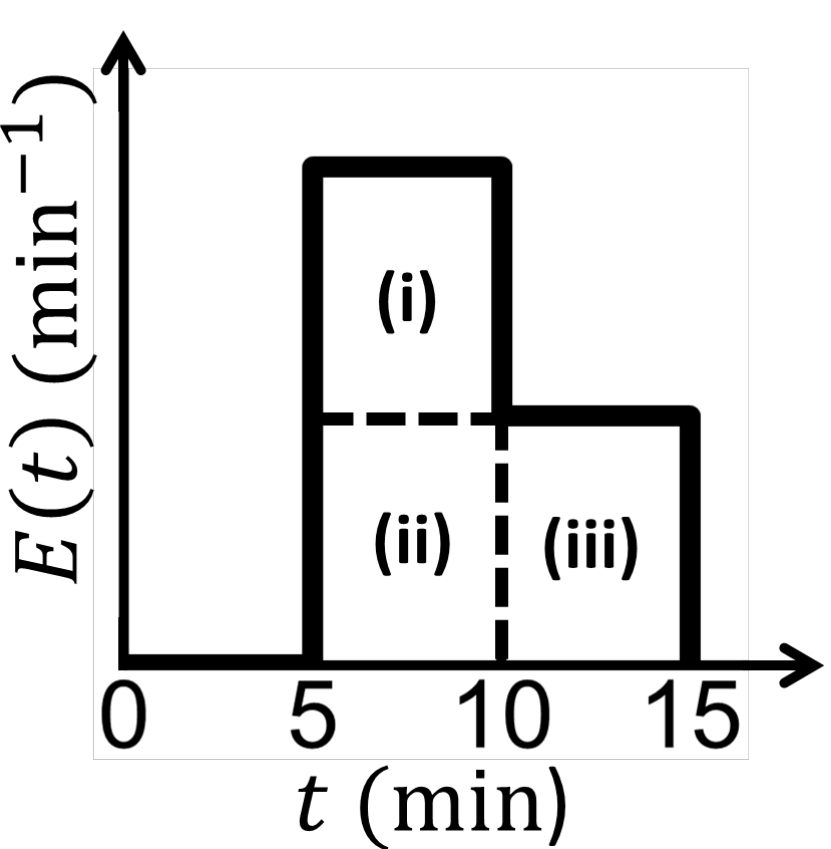
An irreversible liquid-phase second-order reaction $A \xrightarrow{k} B$ with rate constant $k = 0.2$ liter mol$^{-1}$min$^{-1}$, is carried out in an isothermal non-ideal reactor. A tracer experiment conducted on this reactor resulted in a residence time distribution ($E$-curve) as shown in the figure below. The areas of the rectangles (i), (ii), and (iii) are equal. Pure $A$ at a concentration of 1.5 mol liter$^{-1}$ is fed to the reactor. The segregated model mimics the nonideality of this reactor. The percentage conversion of $A$ at the exit of the reactor is ______ (rounded off to the nearest integer).
Practise this question in The GATE Grind →
Show answer and explanation
Correct answer: 72
Explanation
Let the height of rectangle (iii) be $h$. Its area is $5h$, and rectangle (ii), also 5 wide with the same height, has the same area. Rectangle (i) sits on top of (ii) with the same width and the same area, so its height is also $h$. So $E = 2h$ for $5 < t < 10$ and $E = h$ for $10 < t < 15$. The total area is $5(2h) + 5h = 15h = 1$, so $h = \frac{1}{15}$. For a segregated model, $X = \int E(t)X_{batch}(t)dt$, with the batch conversion of a second-order reaction $X_{batch} = \frac{kC_0t}{1 + kC_0t}$ and $kC_0 = 0.3$ min⁻¹. Using $\int\frac{0.3t}{1 + 0.3t}dt = t - \frac{\ln(1 + 0.3t)}{0.3}$: from 5 to 10, $5 - 3.333\ln\frac{4}{2.5} = 3.433$; from 10 to 15, $5 - 3.333\ln\frac{5.5}{4} = 3.938$. Then $X = \frac{2}{15} \times 3.433 + \frac{1}{15} \times 3.938 = 0.458 + 0.263 = 0.720$, which is 72%.