GATE 2022 CH – Question 62
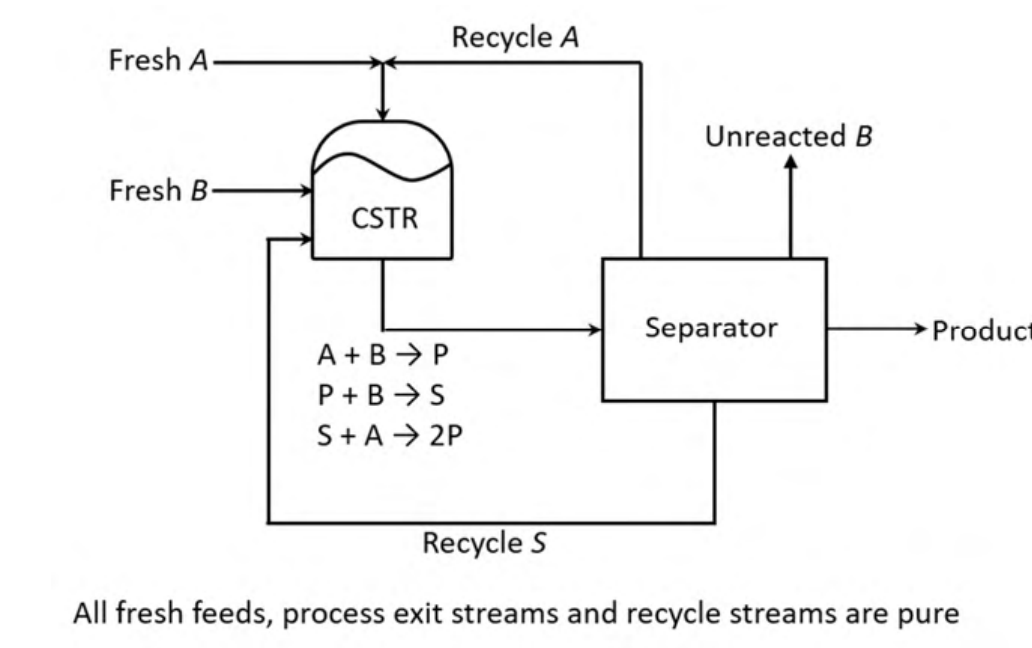
Consider the process in the figure. The liquid phase elementary reactions
$A + B \to P$, $-r_{B1} = k_1x_Ax_B$
$P + B \to S$, $-r_{B2} = k_2x_Px_B$
$S + A \to 2P$, $-r_{S3} = k_3x_Sx_A$
occur in the continuous stirred tank reactor (CSTR), where $x_j$ is the mole fraction of the $j^{th}$ component ($j = A, B, P, S$) in the CSTR. It is given that $k_2 = k_3$. All process feed, process exit and recycle streams are pure. At steady state, the net generation rate of the undesired product, $S$, in the CSTR is zero. As $q = x_A/x_B$ is varied at constant reactor temperature, the reactor volume is adjusted to maintain a constant single-pass conversion of $B$. For a fixed product rate and 90% conversion of $B$ in the reactor, the value of $q$ that minimizes the sum of the molar flow rates of the $A$ and $S$ recycle streams is ________ (round off to one decimal place).
Practise this question in The GATE Grind →
Show answer and explanation
Correct answer: 2.99 to 3.01
Explanation
The net rate of S is $k_2x_Px_B - k_3x_Sx_A = 0$, and with $k_2 = k_3$ this gives $x_S = \frac{x_Px_B}{x_A} = \frac{x_P}{q}$. The net rate of formation of P is $k_1x_Ax_B - k_2x_Px_B + 2k_3x_Sx_A = k_1x_Ax_B + k_2x_Px_B$, which equals the total consumption of B. So the product leaving at the rate $P$ equals the B consumed. With the 90% conversion of B, the B fed to the reactor is $\frac{P}{0.9}$ and the B leaving it is $\frac{P}{9}$. The ratio of the outlet flows is then $n_A = qn_B = \frac{qP}{9}$, $n_P = P$ and $n_S = \frac{n_P}{q} = \frac{P}{q}$. The recycle streams carry the outlet A and S, so their sum is $P\left(\frac{q}{9} + \frac{1}{q}\right)$. Setting the derivative $\frac{1}{9} - \frac{1}{q^2}$ to zero gives $q = 3.0$.