GATE 2022 ME (ME2) – Question 19
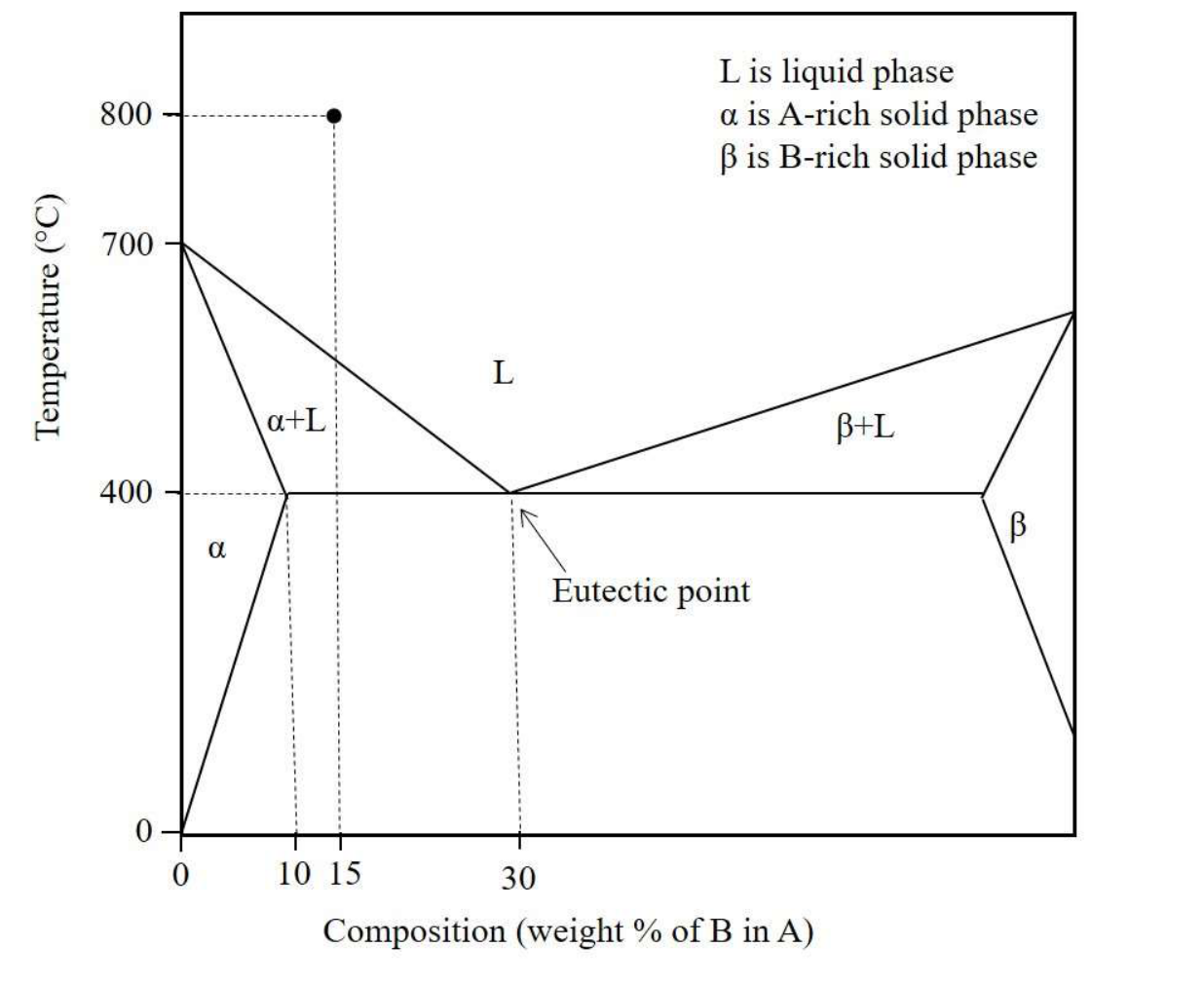
Fluidity of a molten alloy during sand casting depends on its solidification range. The phase diagram of a hypothetical binary alloy of components A and B is shown in the figure with its eutectic composition and temperature. All the lines in this phase diagram, including the solidus and liquidus lines, are straight lines. If this binary alloy with 15 weight % of B is poured into a mould at a pouring temperature of 800 °C, then the solidification range is
Practise this question in The GATE Grind →
Show answer and explanation
Correct answer: (D) 150 °C
Explanation
**Solidification range** is the temperature difference between the liquidus and the solidus at the alloy's composition. The pouring temperature does not enter it.
**Step 1: liquidus at 15 wt% B.** The liquidus is a straight line from pure A (700 °C at 0 wt% B) down to the eutectic (400 °C at 30 wt% B). At 15 wt% B, which is halfway, it is
$$T_L=700-\frac{15}{30}(700-400)=550\ ^\circ\text{C}.$$
**Step 2: solidus at 15 wt% B.** From the diagram the solidus there is the eutectic temperature, $T_S=400\ ^\circ$C.
**Step 3: range.**
$$\Delta T=T_L-T_S=550-400=\mathbf{150\ ^\circ C}.$$
The 800 °C pouring temperature only tells us the alloy is fully liquid at pouring, so it is not part of the range.