GATE 2022 ME (ME2) – Question 39
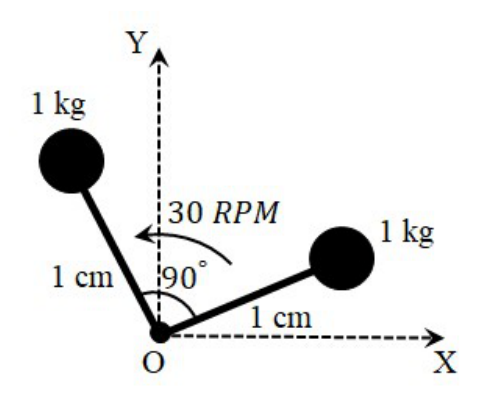
A rigid body in the X-Y plane consists of two point masses (1 kg each) attached to the ends of two massless rods, each of 1 cm length, as shown in the figure. It rotates at 30 RPM counter-clockwise about the Z-axis passing through point O. A point mass of $\sqrt2$ kg, attached to one end of a third massless rod, is used for balancing the body by attaching the free end of the rod to point O. The length of the third rod is ______ cm.
Practise this question in The GATE Grind →
Show answer and explanation
Correct answer: (A) 1
Explanation
**Step 1: unbalance of the two masses.** Each 1 kg mass sits 1 cm from O, so each produces a centrifugal effect $m r\omega^2$ with $mr=1\times1=1$ kg cm. The two rods are perpendicular, so these two vectors are at 90°. Their resultant is
$$mr_{res}=\sqrt{1^2+1^2}=\sqrt2\text{ kg cm}$$
(directed along the bisector of the two rods).
**Step 2: balancing mass.** The balancing mass sits on a third rod opposite to this resultant. The speed $\omega$ is the same for all masses, so $\omega^2$ cancels and the balance condition is
$$m_br_b=\sqrt2 .$$
**Step 3: the rod length.** With $m_b=\sqrt2$ kg,
$$r_b=\frac{\sqrt2}{\sqrt2}=\mathbf{1\ cm}.$$
(The 30 rpm speed does not affect the answer.)