GATE 2022 ME (ME2) – Question 40
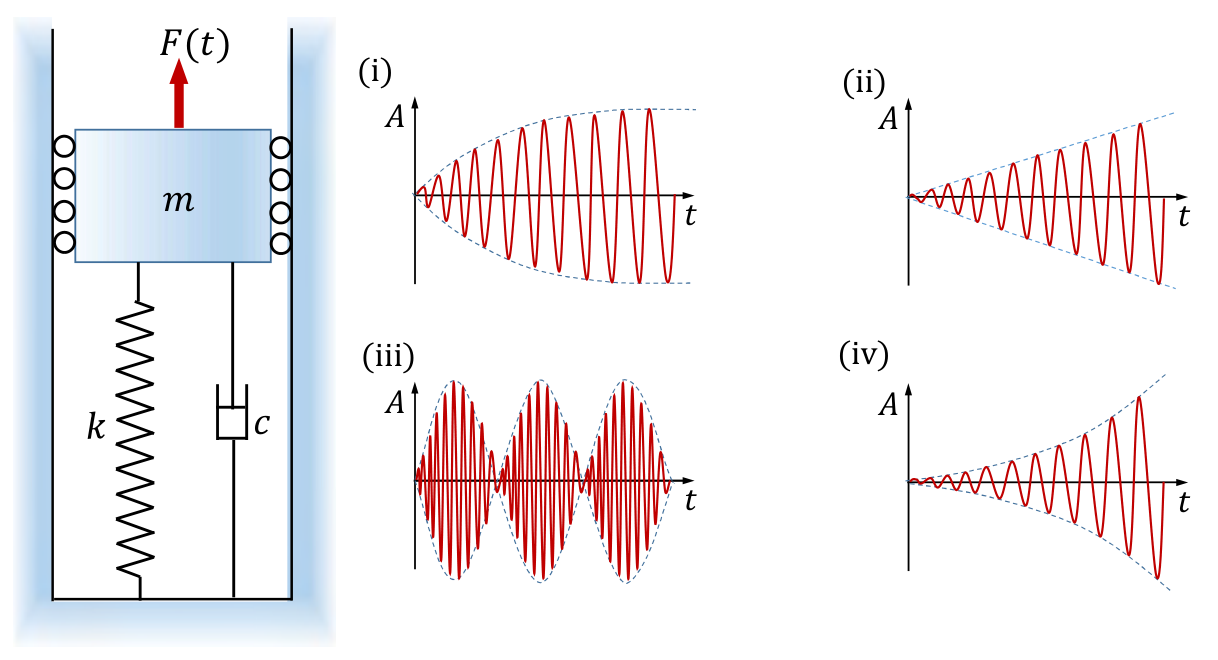
A spring mass damper system (mass m, stiffness k, and damping coefficient c) excited by a force $F(t)=B\sin\omega t$, where B, ω and t are the amplitude, frequency and time, respectively, is shown in the figure. Four different responses of the system (marked as (i) to (iv)) are shown just to the right of the system figure. In the figures of the responses, A is the amplitude of response shown in red color and the dashed lines indicate its envelope. The responses represent only the qualitative trend and those are not drawn to any specific scale. Four different parameter and forcing conditions are mentioned below: (P) $c>0,\omega=\sqrt{k/m}$; (Q) $c<0,\omega\ne0$; (R) $c=0,\omega=\sqrt{k/m}$; (S) $c=0,\omega\cong\sqrt{k/m}$. Which one of the following options gives correct match of the parameter and forcing conditions to the responses?
Practise this question in The GATE Grind →
Show answer and explanation
Correct answer: (C) P-i, Q-iv, R-ii, S-iii
Explanation
Think about the amplitude envelope for each case.
- **(P) $c>0$, $\omega=\sqrt{k/m}$:** a positively damped system under harmonic forcing settles at a **bounded** steady-state amplitude, with a transient that dies out. This is response (i).
- **(Q) $c<0$:** negative damping feeds energy in, so the amplitude **grows exponentially**. This is (iv).
- **(R) $c=0$, $\omega=\sqrt{k/m}$:** an undamped system driven exactly at resonance has an amplitude that grows **linearly** with time. This is (ii).
- **(S) $c=0$, $\omega\cong\sqrt{k/m}$:** the forced and natural oscillations at nearby frequencies add up to **beats**. This is (iii).
Match: **P-i, Q-iv, R-ii, S-iii** (option C).