GATE 2022 ME (ME2) – Question 54
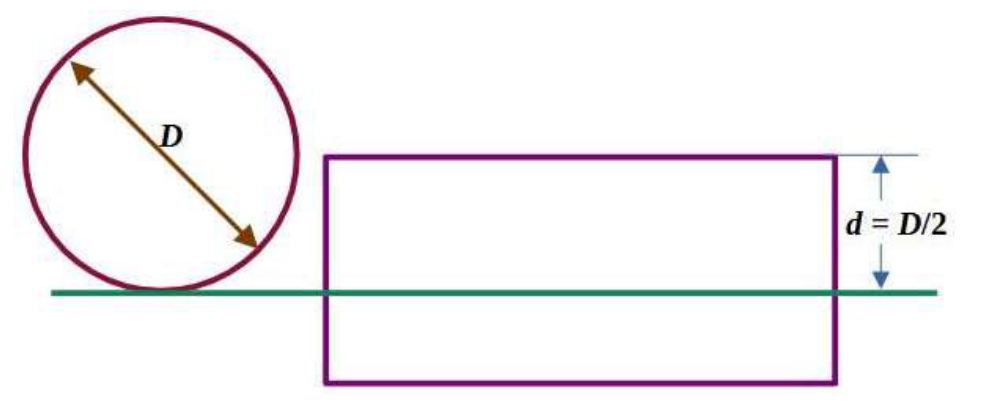
A straight-teeth horizontal slab milling cutter is shown in the figure. It has 4 teeth and diameter (D) of 200 mm. The rotational speed of the cutter is 100 rpm and the linear feed given to the workpiece is 1000 mm/minute. The width of the workpiece (w) is 100 mm, and the entire width is milled in a single pass of the cutter. The cutting force/tooth is given by $F=Kt_cw$, where specific cutting force $K=10$ N/mm$^2$, w is the width of cut, and $t_c$ is the uncut chip thickness. The depth of cut (d) is D/2, and hence the assumption of $d/D\ll1$ is invalid. The maximum cutting force required is ______ kN (round off to one decimal place).
Practise this question in The GATE Grind →
Show answer and explanation
Correct answer: 2.49 to 2.51
Explanation
**Step 1: feed per tooth.** The cutter has 4 teeth and turns at 100 rpm, with a table feed of 1000 mm/min:
$$f_t=\frac{1000}{100\times4}=2.5\text{ mm per tooth}.$$
**Step 2: chip thickness.** The depth of cut is $D/2$, so the arc of engagement is large: $\cos\phi=1-\dfrac{2d}{D}=0$, i.e. $\phi=90^\circ$. For slab milling the uncut chip thickness is $t_c=f_t\sin\psi$, where $\psi$ is the angle from the start of the cut. The maximum occurs at $\psi=90^\circ$, at the end of the engagement arc, where $\sin\psi=1$. So
$$t_{c,max}=f_t=2.5\text{ mm}.$$
**Step 3: maximum force.** With $F=K\,t_c\,w$:
$$F_{max}=10\times2.5\times100=2500\text{ N}=\mathbf{2.5\ kN}.$$
Because the engagement is $90^\circ$ and the teeth are $90^\circ$ apart, one tooth leaves as the next enters, so only one tooth is cutting at a time.