GATE 2023 CE (CE2) – Question 54
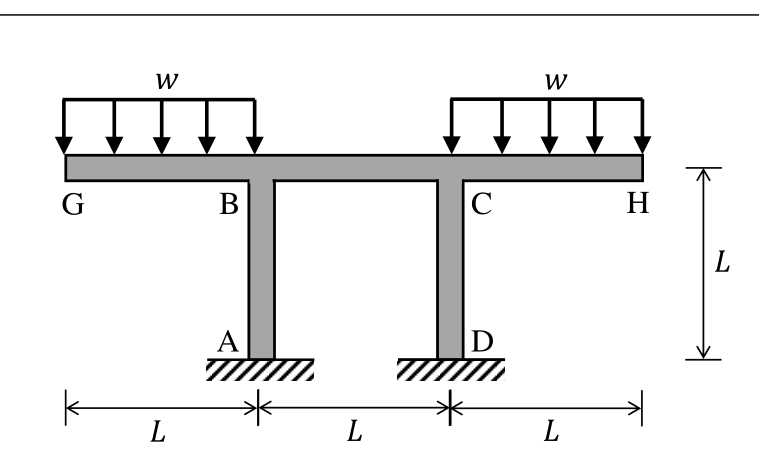
For the frame shown in the figure (not to scale), all members (AB, BC, CD, GB, and CH) have the same length, L and flexural rigidity, EI. The joints at B and C are rigid joints, and the supports A and D are fixed supports. Beams GB and CH carry uniformly distributed loads of w per unit length. The magnitude of the moment reaction at A is $wL^2/k$. What is the value of k (in integer)?
Practise this question in The GATE Grind →
Show answer and explanation
Correct answer: 6
Explanation
**Step 1: symmetry.** The frame and its loads are symmetric about the vertical centre line, so there is no sway. The joint rotations at B and C are equal in size and opposite in sense ($\theta_C=-\theta_B$).
**Step 2: moment from the overhang.** The cantilever overhang GB carries a UDL $w$ over a length $L$. It applies a moment at joint B of
$$M_{ov}=\frac{wL^2}{2}.$$
**Step 3: rotational stiffness at B.**
- Column AB (far end A fixed): $\dfrac{4EI}{L}$.
- Beam BC: because the deformation is symmetric, its far end C rotates by an equal and opposite angle, and the stiffness is $\dfrac{2EI}{L}$.
Joint equilibrium at B:
$$\left(\frac{4EI}{L}+\frac{2EI}{L}\right)\theta_B=\frac{wL^2}{2}\;\Rightarrow\;\theta_B=\frac{wL^3}{12EI}.$$
**Step 4: moment at the fixed base A.** The carry-over factor is ½, so
$$M_A=\frac12\left(\frac{4EI}{L}\right)\theta_B=\frac{2EI}{L}\cdot\frac{wL^3}{12EI}=\frac{wL^2}{6}.$$
So $k=\mathbf{6}$.