GATE 2024 CY – Question 35
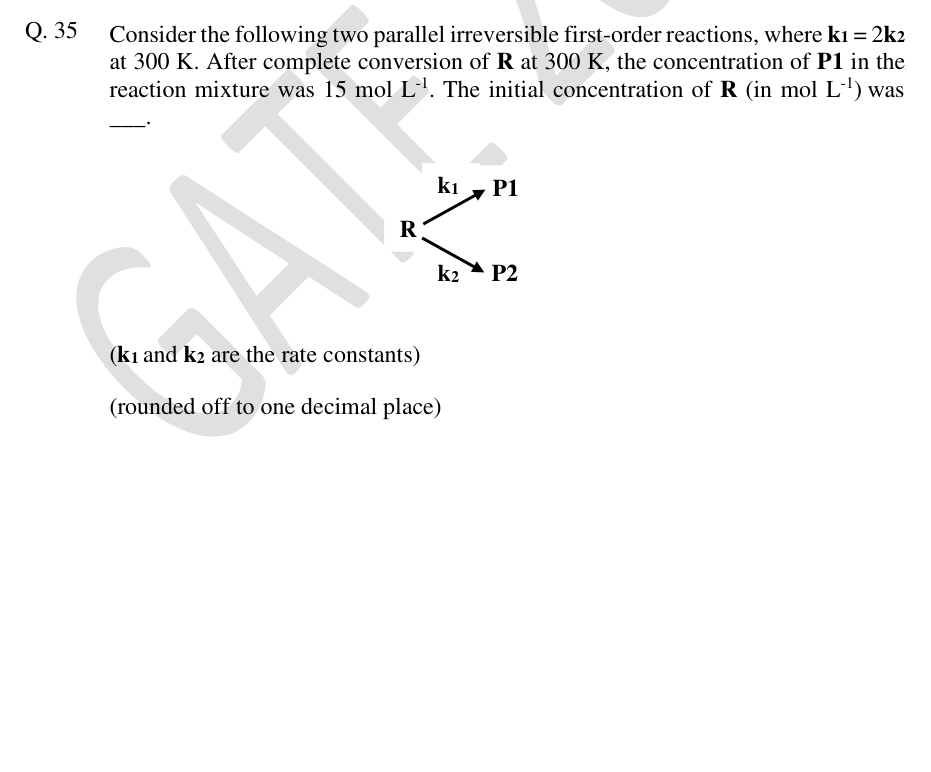
Consider the following two parallel irreversible first-order reactions, where $k_1=2k_2$ at 300 K. After complete conversion of R at 300 K, the concentration of P1 in the reaction mixture was $15\ \mathrm{mol\,L^{-1}}$. The initial concentration of R (in $\mathrm{mol\,L^{-1}}$) was ___. ($k_1$ and $k_2$ are the rate constants) (rounded off to one decimal place)
Practise this question in The GATE Grind →
Show answer and explanation
Correct answer: 22.39 to 22.61
Explanation
R reacts by two parallel, irreversible first-order reactions, $R\xrightarrow{k_1}P_1$ and $R\xrightarrow{k_2}P_2$.
**Branching ratio.** Both reactions consume R at the same time, so the products form in the ratio of the rate constants. After complete conversion, the fraction of R that ended as $P_1$ is
$$\frac{[P_1]}{[R]_0}=\frac{k_1}{k_1+k_2}.$$
With $k_1=2k_2$:
$$\frac{k_1}{k_1+k_2}=\frac{2k_2}{3k_2}=\frac23 .$$
**Initial concentration:**
$$[R]_0=\frac{[P_1]}{2/3}=\frac{15}{2/3}=\mathbf{22.5\ mol\,L^{-1}}.$$