GATE 2025 CY – Question 14
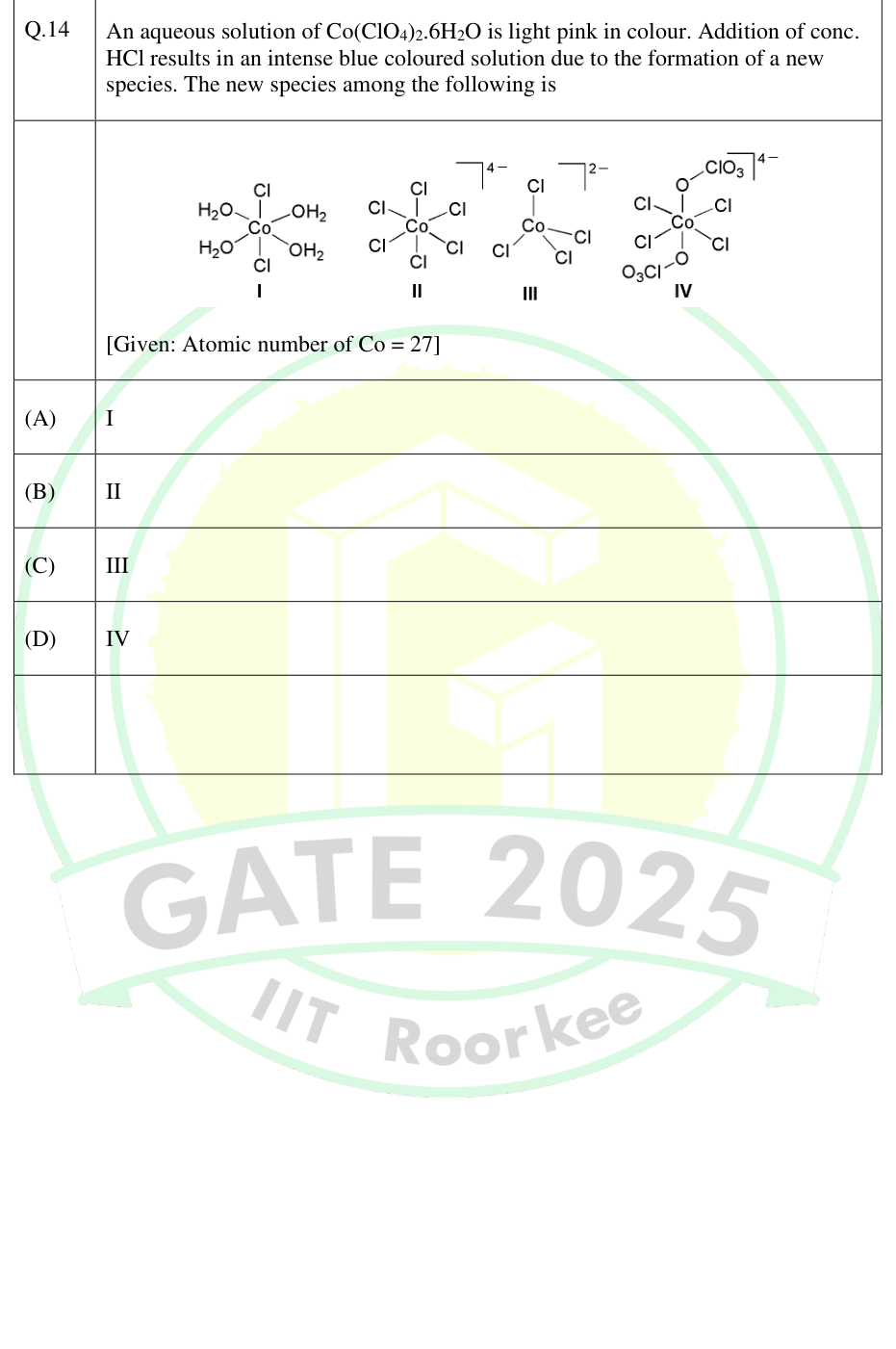
An aqueous solution of $\mathrm{Co(ClO_4)_2\cdot6H_2O}$ is light pink in colour. Addition of conc. HCl results in an intense blue coloured solution due to the formation of a new species. The new species among the following is [Given: Atomic number of Co = 27]
Practise this question in The GATE Grind →
Show answer and explanation
Correct answer: (C) III
Explanation
**Aqueous solution.** $\text{Co}^{2+}$ in water forms the octahedral hexaaqua complex $[\text{Co(H}_2\text{O)}_6]^{2+}$, which is **light pink**.
**Adding concentrated HCl.** The large concentration of chloride ions replaces the water ligands:
$$[\text{Co(H}_2\text{O)}_6]^{2+}+4\,\text{Cl}^-\rightleftharpoons[\text{CoCl}_4]^{2-}+6\,\text{H}_2\text{O}.$$
Chloride is a bigger ligand than water, and $d^7$ $\text{Co(II)}$ with four large ligands prefers a **tetrahedral** geometry. A tetrahedral complex has a smaller crystal-field splitting ($\Delta_t\approx\tfrac49\Delta_o$) and no centre of symmetry, so the $d$-$d$ bands are much more intense and shift to lower energy. The result is the intense **blue** $[\text{CoCl}_4]^{2-}$ (option C, the tetrahedral species).