GATE 2025 CY – Question 42
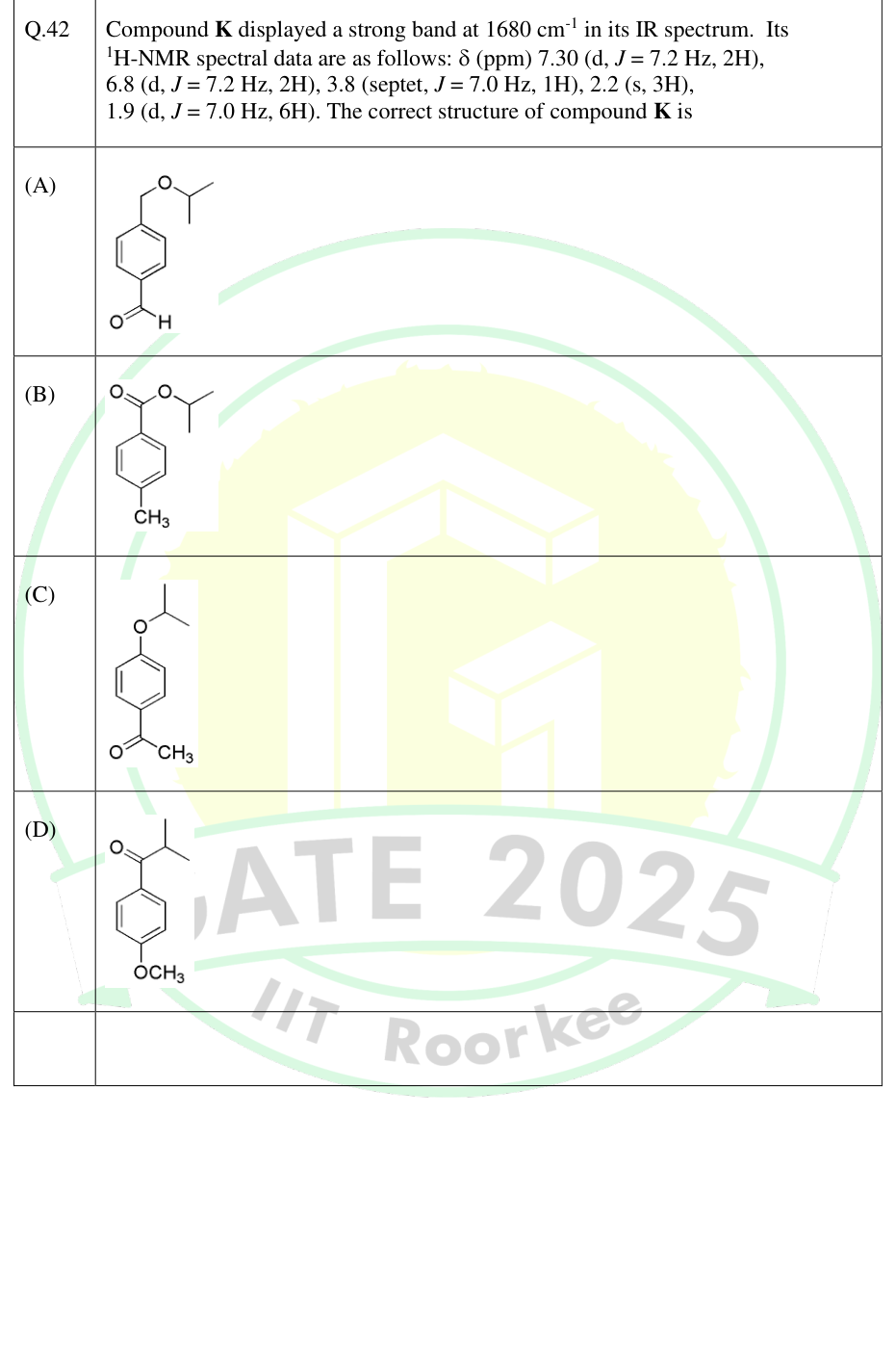
Compound K has a strong IR band at 1680 cm−1. Its $^1$H NMR data: $\delta$ (ppm) 7.30 (d, J = 7.2 Hz, 2H), 6.8 (d, J = 7.2 Hz, 2H), 3.8 (septet, J = 7.0 Hz, 1H), 2.2 (s, 3H), 1.9 (d, J = 7.0 Hz, 6H). Its correct structure is
Practise this question in The GATE Grind →
Show answer and explanation
Correct answer: (C) Option C in the figure
Explanation
Two aromatic 2H doublets indicate para substitution. The septet and 6H doublet identify an isopropoxy group, and the 3H singlet at 2.2 ppm identifies an acetyl methyl. These features fit C.