GATE 2024 PH – Question 50
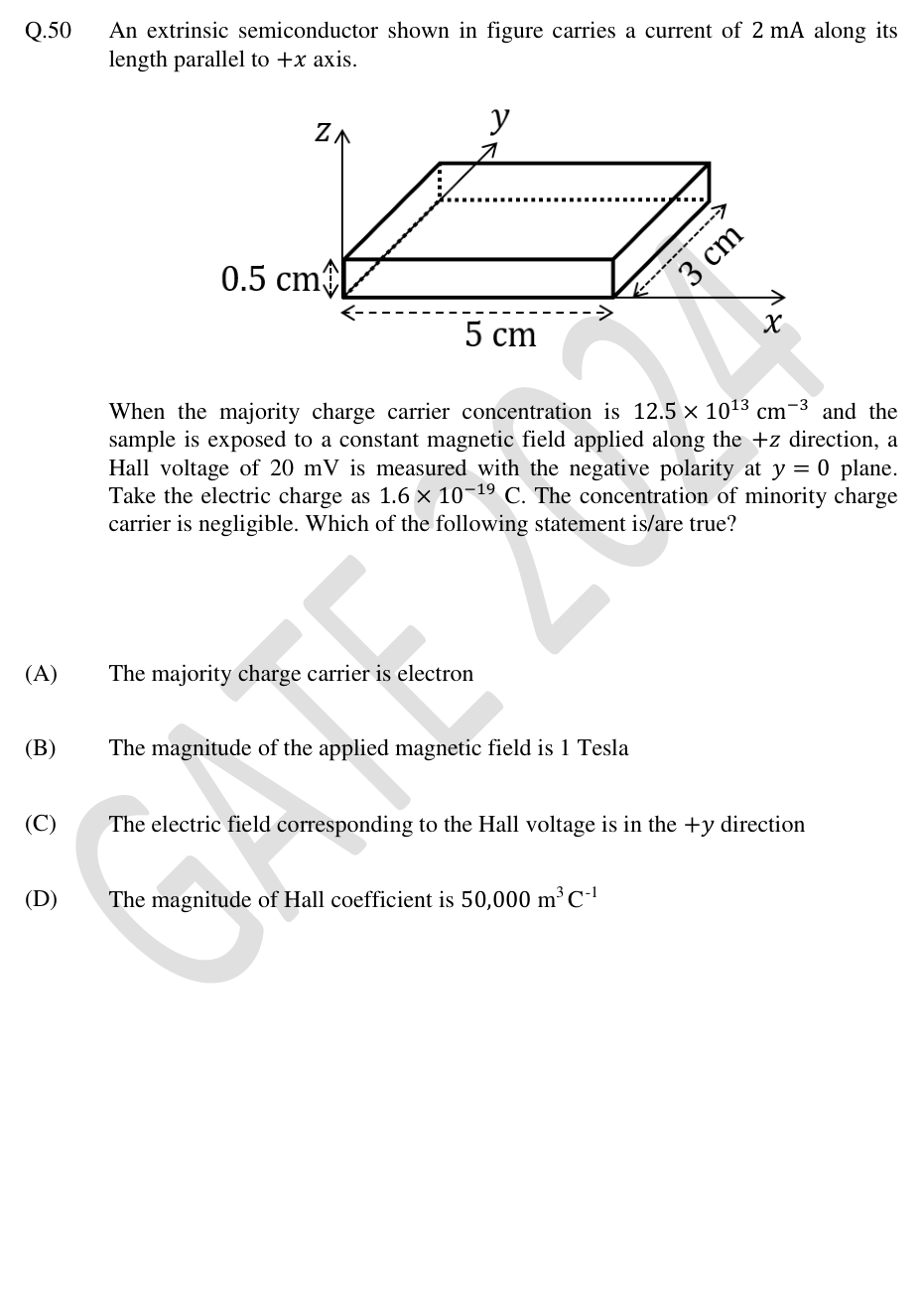
The semiconductor shown carries 2 mA along +x. Majority carrier concentration is $12.5\times10^{13}$ cm−3, with negligible minority carriers. In a constant +z magnetic field, the Hall voltage is 20 mV, negative at y = 0. Take $e=1.6\times10^{-19}$ C. Which statement(s) is/are true?
Practise this question in The GATE Grind →
Show answer and explanation
Correct answer: (A) The majority charge carrier is electron; (B) The magnitude of the applied magnetic field is 1 Tesla
Explanation
**Setting.** Current $I=2$ mA along $+x$, magnetic field along $+z$, Hall voltage across the width, thickness $t=0.5$ cm $=5\times10^{-3}$ m, carrier concentration $n=12.5\times10^{13}\text{ cm}^{-3}=1.25\times10^{20}\text{ m}^{-3}$.
**A. The sign of the carriers.** The magnetic force on a moving carrier is $q\,\mathbf v\times\mathbf B$. The current flows along $+x$ and the field along $+z$.
- If the carriers were **positive**, they would move along $+x$, and $\hat x\times\hat z=-\hat y$ pushes them toward $y=0$, making that face **positive**.
- If the carriers are **electrons**, they move along $-x$. The force is $(-e)(-v\hat x)\times B\hat z=evB\,(\hat x\times\hat z)=-evB\,\hat y$, which also pushes them toward $y=0$, and that face becomes **negative**.
The measured voltage is negative at $y=0$, so the carriers are **electrons**. ✓
**B. Magnetic field.** For a Hall sample $V_H=\dfrac{IB}{nte}$, so
$$B=\frac{V_H\,n\,t\,e}{I}=\frac{(20\times10^{-3})(1.25\times10^{20})(5\times10^{-3})(1.6\times10^{-19})}{2\times10^{-3}}=1\text{ T}. ✓$$
**C. Direction of the Hall field.** The field points from the positive side to the negative side. If $y=0$ is negative, $E_y$ points toward $y=0$, that is **$-y$**. So the statement "+y direction" is false.
**D. Hall coefficient.** $|R_H|=\dfrac{1}{ne}=\dfrac{1}{1.25\times10^{20}\times1.6\times10^{-19}}=0.05\text{ m}^3/\text{C}$, not 50 000. False.
Answer **A and B**.