GATE 2026 PH – Question 49
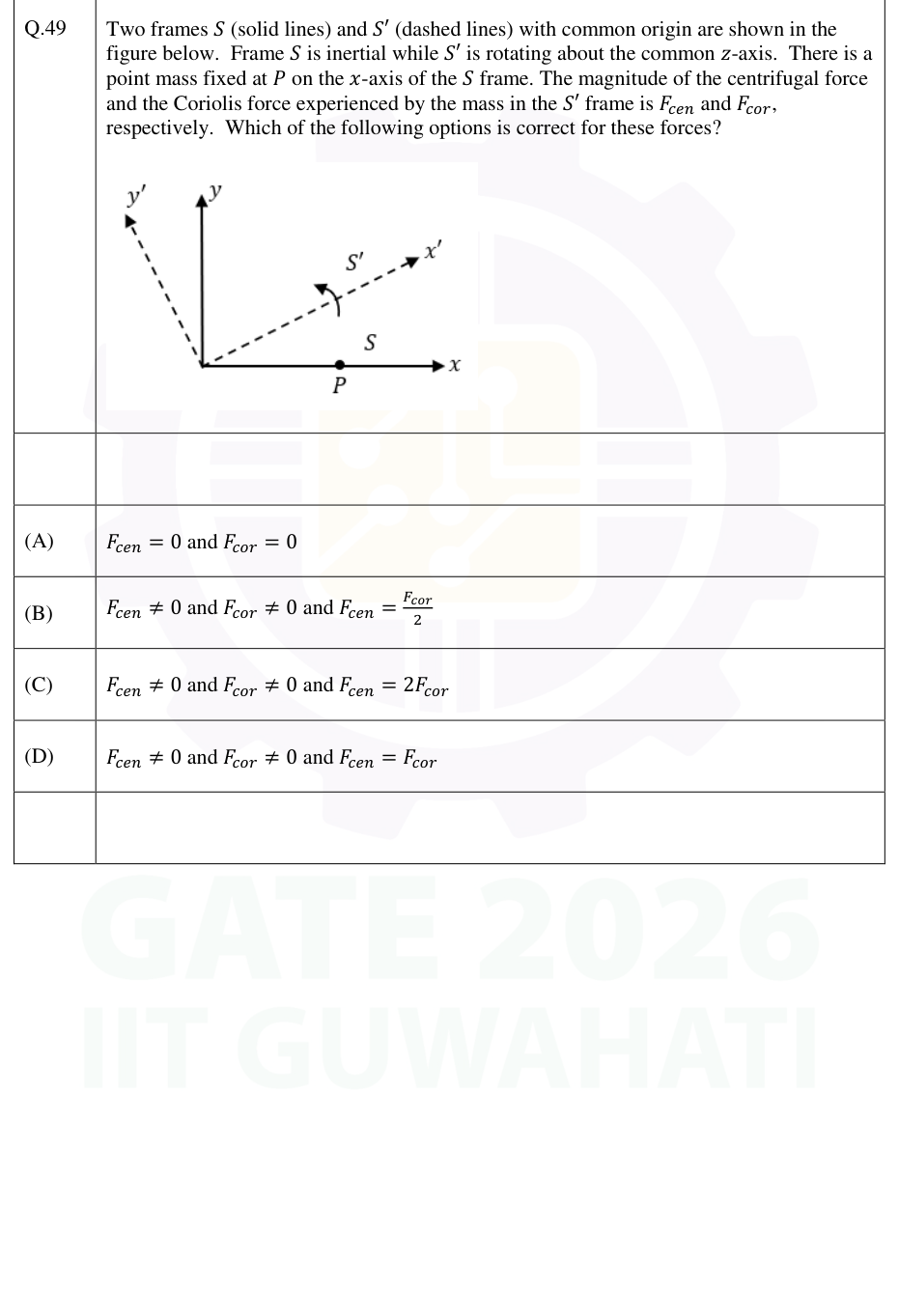
Two frames S (solid lines) and S′ (dashed lines) with common origin are shown in the figure below. Frame S is inertial while S′ is rotating about the common z-axis. There is a point mass fixed at P on the x-axis of the S frame. The magnitude of the centrifugal force and the Coriolis force experienced by the mass in the S′ frame is Fcen and Fcor, respectively. Which of the following options is correct for these forces?
Practise this question in The GATE Grind →
Show answer and explanation
Correct answer: (B) $F_{cen}\ne0$ and $F_{cor}\ne0$ and $F_{cen}=F_{cor}/2$
Explanation
The mass sits at rest at the point P in the **inertial** frame. In the rotating frame S′ (angular velocity $\boldsymbol\Omega$ about $z$) it moves in a circle of radius $r$ with velocity
$$\mathbf v^\prime=-\boldsymbol\Omega\times\mathbf r,\qquad|\mathbf v^\prime|=\Omega r .$$
**Fictitious forces in the rotating frame:**
- **Centrifugal:** $\mathbf F_{cen}=-m\boldsymbol\Omega\times(\boldsymbol\Omega\times\mathbf r)$, with magnitude
$$F_{cen}=m\Omega^2r .$$
- **Coriolis:** $\mathbf F_{cor}=-2m\boldsymbol\Omega\times\mathbf v^\prime$, with magnitude (the velocity is perpendicular to $\boldsymbol\Omega$)
$$F_{cor}=2m\Omega v^\prime=2m\Omega^2r .$$
Both are non-zero, and
$$F_{cen}=\frac{F_{cor}}{2}\quad(\text{option B}).$$
(Consistency check: the net force on the mass in the rotating frame is $\mathbf F_{cen}+\mathbf F_{cor}$, which has magnitude $m\Omega^2r$ pointing towards the axis, exactly the centripetal force for circular motion at radius $r$, because in the inertial frame the mass feels no force.)