GATE 2021 CH – Question 27
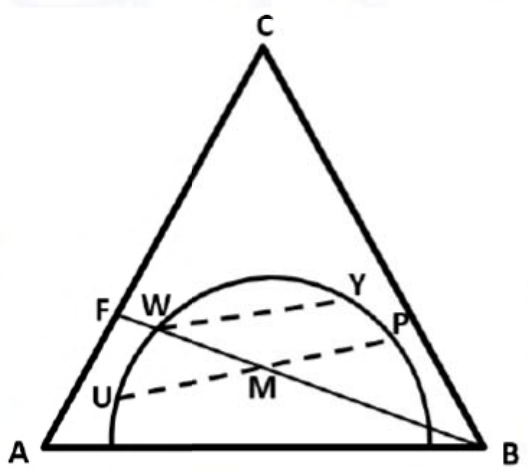
Feed solution F is contacted with solvent B in an extraction process. Carrier liquid in the feed is A and the solute is C. The ternary diagram depicting a single ideal stage extraction is given below. The dashed lines represent the tie-lines. The CORRECT option(s) is/are
Practise this question in The GATE Grind →
Show answer and explanation
Correct answer: (A) For the tie-lines shown, concentration of solute in the extract is higher than that in the raffinate; (C) Y represents the composition of extract when minimum amount of solvent is used; (D) U represents the raffinate composition if the mixture composition is at M
Explanation
Adding solvent B moves the mixture point from F towards B on line F–B. The **first** entry into the two-phase region is W, so W corresponds to the **minimum**, not maximum, solvent addition; B is false. Its tie-line ends at Y on the solvent-rich side, so C is true.
For a mixture at M, follow the dashed tie-line through M to its carrier-rich end U: this is the raffinate, making D true. On both drawn tie-lines the solvent-rich endpoint lies at a higher solute-C concentration than the carrier-rich endpoint, making A true. **Answer: A, C and D.**