GATE 2021 ME (ME1) – Question 40
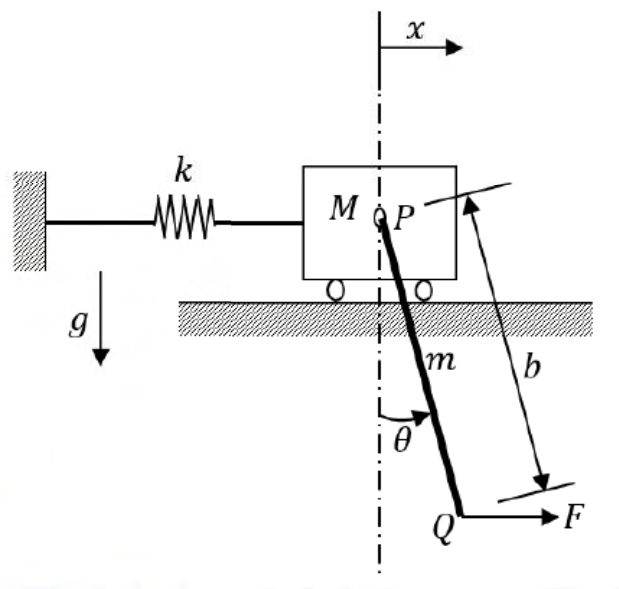
Consider a two degree of freedom system as shown in the figure, where PQ is a rigid uniform rod of length, $b$ and mass, $m$. Assume that the spring deflects only horizontally and force $F$ is applied horizontally at Q. For this system, the Lagrangian, $L$ is
Practise this question in The GATE Grind →
Show answer and explanation
Correct answer: (B) $\frac12(M+m)\dot x^2+\frac12mb\dot x\dot\theta\cos\theta+\frac16mb^2\dot\theta^2-\frac12kx^2+\frac12mgb\cos\theta$
Explanation
The rod centre velocity contributes the coupling term $mb\dot x\dot\theta\cos\theta/2$. Including its translation and rotation, $T=(M+m)\dot x^2/2+mb\dot x\dot\theta\cos\theta/2+mb^2\dot\theta^2/6$.
Potential energy is $kx^2/2-mgb\cos\theta/2$. Therefore **B** gives T−V. F is treated as an applied generalized force in this formulation, rather than included in the displayed Lagrangian.