GATE 2020 ME (ME1) – Question 59
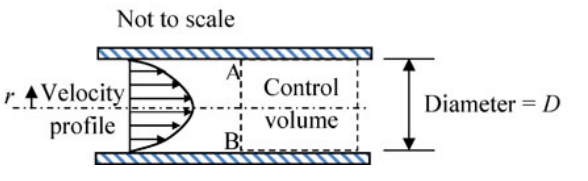
Consider steady, viscous, fully developed flow through a circular pipe of internal diameter D. Its parabolic velocity profile is $V=-C(r^2-D^2/4)$ m/s, where C is constant. The kinetic-energy flow rate (J/s) across control surface A–B is proportional to $D^n$. Find n.
Practise this question in The GATE Grind →
Show answer and explanation
Correct answer: 8 to 8
Explanation
Kinetic-energy flux is $(\rho/2)\int_A V^3dA$. With r=Dξ, velocity scales as D² and area as D². Hence the flux scales as $(D^2)^3D^2=D^8$, so **n=8**. Using V² alone would give stored energy, not the energy transported per second.