GATE 2024 EC – Question 49
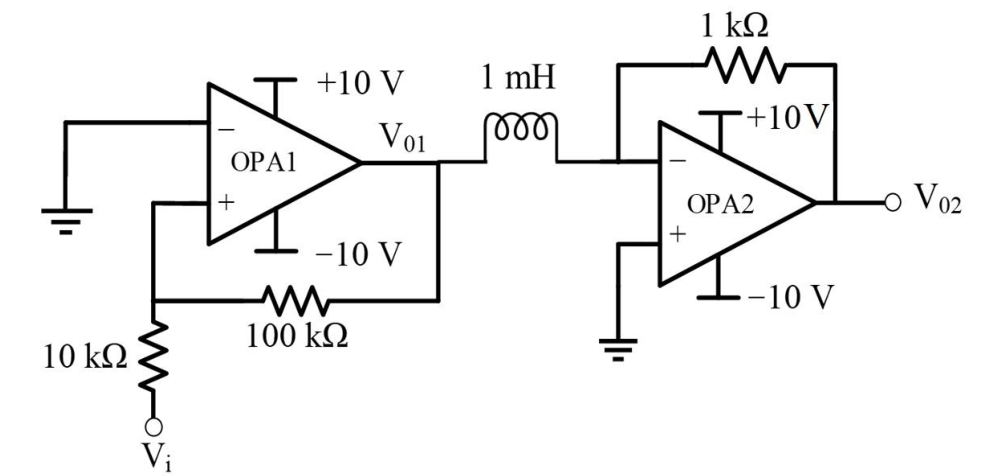
The opamps in the circuit shown are ideal, but have saturation voltages of $\pm10$ V.
Assume that the initial inductor current is 0 A. The input voltage ($V_i$) is a triangular signal with peak voltages of $\pm2$ V and time period of 8 μs. Which one of the following statements is true?
Practise this question in The GATE Grind →
Show answer and explanation
Correct answer: (D) $V_{o1}$ is delayed by 1 μs relative to $V_i$, and $V_{o2}$ is a trapezoidal waveform.
Explanation
OPA1 is a non-inverting Schmitt trigger. Its non-inverting input is $\dfrac{100V_i+10V_{o1}}{110}$, so it switches when $V_i=-V_{o1}/10$, i.e. thresholds $\mp1$ V: $V_{o1}$ goes high when $V_i$ rises through $+1$ V and low when it falls through $-1$ V. A triangle with peak 2 V and period 8 μs has slope 1 V/μs, so it crosses $+1$ V one microsecond after its zero crossing: $V_{o1}$ is a $\pm10$ V square wave delayed by 1 μs. OPA2 with the inductor at its input and 1 kΩ feedback is an integrator, $V_{o2}=-\frac{R}{sL}V_{o1}$, with $R/L=10^6$ s$^{-1}$, so it ramps at 10 V/μs. It saturates at $\pm10$ V after 2 μs of each 4 μs half-cycle, giving a trapezoidal waveform.