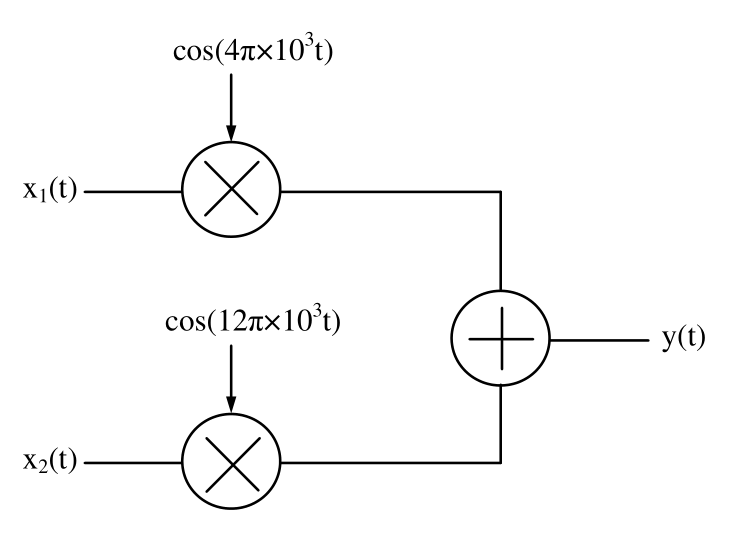
Let $x_1(t)$ and $x_2(t)$ be two band-limited signals having bandwidth $B=4\pi\times10^3$ rad/s each. In the figure below, the Nyquist sampling frequency, in rad/s, required to sample $y(t)$, is
$x_1$ is multiplied by $\cos(4\pi\times10^3t)$, so it occupies up to $4\pi\times10^3+4\pi\times10^3=8\pi\times10^3$ rad/s. $x_2$ is multiplied by $\cos(12\pi\times10^3t)$ and occupies up to $12\pi\times10^3+4\pi\times10^3=16\pi\times10^3$ rad/s. The highest frequency in $y(t)$ is $16\pi\times10^3$, so the Nyquist rate is $2\times16\pi\times10^3=32\pi\times10^3$ rad/s.
More Analog Communications questions
GATE 2022 EC Q51– Consider an FM broadcast that employs the pre-emphasis filter with frequency response H…
GATE 2021 EC Q32– Consider a carrier signal which is amplitude modulated by a single-tone sinusoidal message…
GATE 2021 EC Q59– A sinusoidal message signal having root mean square value of 4 V and frequency of 1 kHz is…
GATE 2021 EC Q60– Consider a superheterodyne receiver tuned to 600 kHz. If the local oscillator feeds a 1000…
GATE 2020 EC Q52– For the modulated signal x(t)=m(t)(2 f ct), the message signal m(t)=4(1000 t) and the…
GATE 2020 EC Q57– S PM(t) and S FM(t) as defined below, are the phase modulated and the frequency modulated…