GATE 2026 EE – Question 22
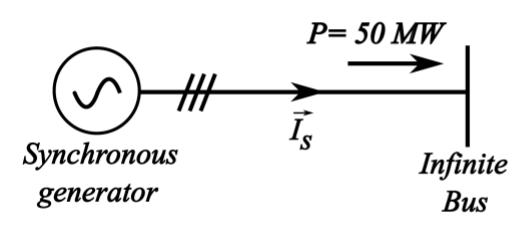
The figure shows the single-line diagram of a synchronous generator delivering $P=50$ MW of power at unity power factor to an infinite bus.
$\bar I_s$ denotes the stator current phasor. If the field excitation is increased, which one of the following options correctly describes its effect on the stator current, power factor, and load angle of the machine?
Practise this question in The GATE Grind →
Show answer and explanation
Correct answer: (C) Stator current increases, power factor becomes lagging, load angle decreases
Explanation
The real power stays 50 MW. Raising the excitation ($E_f$) makes the machine over-excited, so it supplies reactive power: the current gets a lagging component, the stator current magnitude rises and the power factor becomes lagging. Since $P\propto E_fV\sin\delta$ is constant, a larger $E_f$ means a smaller $\sin\delta$: the load angle decreases.