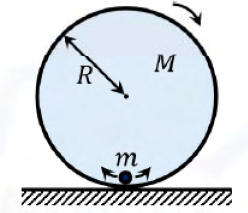
A hoop of mass $M$ and radius $R$ rolls without slipping along a straight line on a horizontal surface. A point mass $m$ slides without friction along its inner surface and performs small oscillations about its mean position. Find the number of degrees of freedom of the system as an integer.
One coordinate specifies the hoop’s horizontal displacement. Its rotation is then fixed by the no-slip constraint $x=R\phi$, while its centre remains at height $R$. A second independent coordinate specifies the point mass’s angular position on the hoop. The frictionless point is not constrained to rotate with the hoop. Thus two independent generalized coordinates, and hence two degrees of freedom, are required.
More D'Alembert's principle, Euler-Lagrange equation, Hamilton's principle, calculus of variations questions
GATE 2021 PH Q54– A uniform block of mass M slides on a smooth horizontal bar. A mass m hangs from it on an…
GATE 2021 PH Q56– The total time derivative of a differentiable function g(q i,t) is added to a Lagrangian:…
GATE 2024 PH Q60– L=m x2/2- x4 with positive lambda. At total energy E, T=a 0(E/)1/4dx(2/m)(E- x4). The…
GATE 2026 PH Q16– On a horizontal plane, a projectile of mass m is launched from the ground with speed v 0…
GATE 2026 PH Q28– A projectile of mass m is launched from the ground with the initial speed v 0 at an angle…
GATE 2026 PH Q46– The Lagrangian L 0=12m q2-12m2q2 with the generalized coordinate q is transformed to L=L…