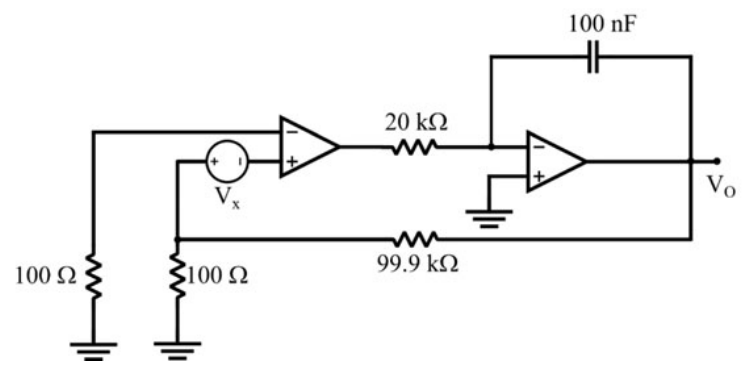
At steady state the integrator output is constant, so its input current and the preceding amplifier output must be zero. The feedback loop therefore nulls the first amplifier’s differential input. The 99.9 kΩ/100 Ω divider feeds back $V_o/1000$ against Vₓ, giving $V_o/1000=0.5$ mV. Thus Vₒ = 0.50 V. The capacitor controls settling dynamics but not this final null condition.
More Operational amplifiers and applications: Ideal and practical op-amps, adder, subtractor, integrator, differentiator, difference and instrumentation amplifiers, precision rectifier, active filters, comparators, Schmitt trigger questions
GATE 2026 IN Q45– In the circuit shown below, R=1\ k and R f=10\ k. If V in=100\ mV and the op-amps have…
GATE 2026 IN Q46– In the following active-filter circuit with ideal op-amps, R=1\ k and C=1\ F. The input V…
GATE 2025 IN Q20– For the ideal-opamp circuit shown, the ratio V/I is
GATE 2025 IN Q31– The circuits mentioned in the following options are realized using ideal opamp. Among…
GATE 2024 IN Q41– The opamps A 1,A 2 shown are ideal, except that A 1 has offset voltage V OS=1 mV. For V…
GATE 2024 IN Q43– In the circuit shown, R = 1 kΩ and C = 0.1 μF. For a DC gain of −10, the 3 dB cutoff…