GATE 2023 EE – Question 20
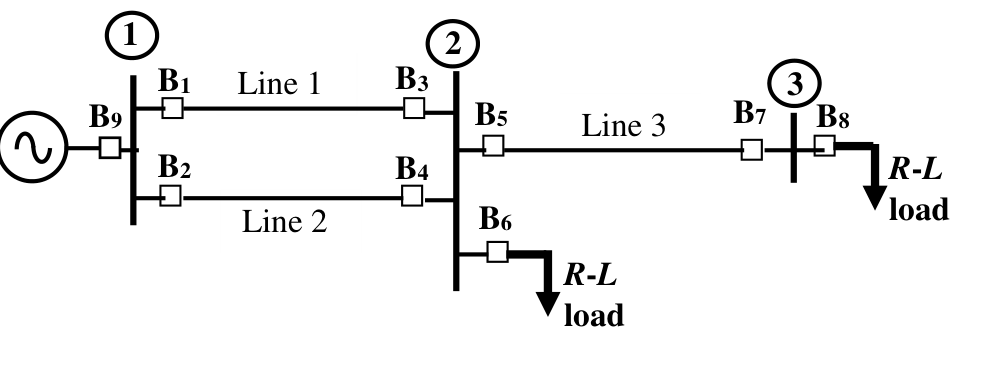
For the three-bus power system shown in the figure, the trip signals to the circuit breakers $B_1$ to $B_9$ are provided by overcurrent relays $R_1$ to $R_9$, respectively, some of which have directional properties also. The necessary condition for the system to be protected for short circuit fault at any part of the system between bus 1 and the R-L loads with isolation of minimum portion of the network using minimum number of directional relays is
Practise this question in The GATE Grind →
Show answer and explanation
Correct answer: (A) $R_3$ and $R_4$ are directional overcurrent relays blocking faults towards bus 2
Explanation
Lines 1 and 2 are in parallel between buses 1 and 2. For a fault on one of them, the healthy line can feed the fault from bus 2 through its bus-2 breaker. Directional relays $R_3$ and $R_4$ at the bus-2 ends of the two lines block current flowing back toward bus 1 from bus 2, so only the faulty line trips. Line 3 is radial (it has a single source), so it needs no directional relays.