GATE 2017 CS (CS2) – Question 31
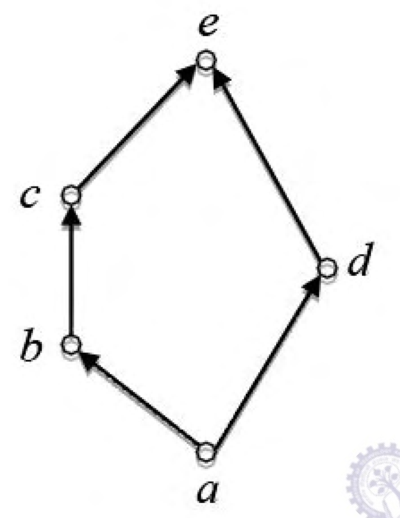
X={a,b,c,d,e} has partial order R={(a,a),(a,b),(a,c),(a,d),(a,e),(b,b),(b,c),(b,e),(c,c),(c,e),(d,d),(d,e),(e,e)}, with Hasse diagram shown. How many ordered pairs must minimally be added to make it a lattice?
Practise this question in The GATE Grind →
Show answer and explanation
Correct answer: -0.01 to 0.01
Explanation
The diagram is the pentagon lattice N₅. The chain a<b<c<e coexists with a<d<e. Comparable pairs already have meet/join. For incomparable d,b and d,c, the meet is a and join is e. Thus every pair already has both, and zero added pairs are required.
More Discrete Mathematics: Sets, Relations, Functions, Partial Orders and Lattices questions
- GATE 2010 CS (CS1) Q13
- GATE 2015 CS (CS2) Q12
- GATE 2015 CS (CS2) Q13
- GATE 2015 CS (CS3) Q12
- GATE 2015 CS (CS3) Q60
- GATE 2021 CS (CS2) Q21
All Discrete Mathematics: Sets, Relations, Functions, Partial Orders and Lattices questions →